What is Storyblok? A Complete Guide for B2B Marketing and Digital Teams

If your marketing team has to open a Jira ticket just to fix a typo, your website stack is broken. We’ve spent years helping B2B teams scale their digital engines, and the #1 growth killer we see is a legacy CMS that forces marketers to beg developers for every single page update.
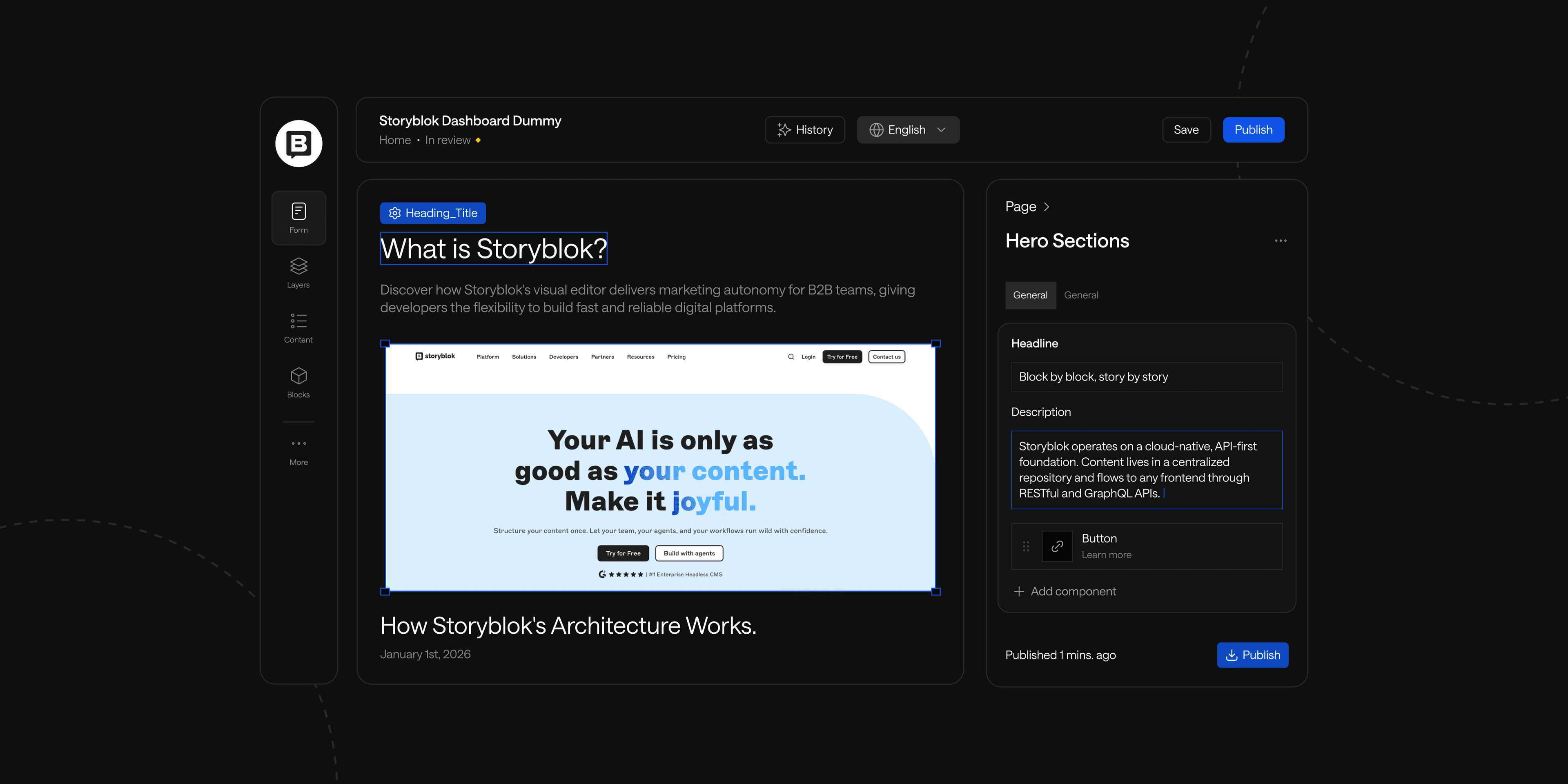
As a modern headless CMS, Storyblok pairs a flexible, component-based architecture with an intuitive visual editor. This setup gives marketing teams the autonomy to launch, test, and localize content on the fly, while ensuring developers retain full control over code architecture and brand guardrails.
That balance is why it ranks as the only CMS named a Customers' Choice in the Gartner Peer Insights Voice of the Customer: Web Content Management report and was named a Leader in the 2025 IDC MarketScape: Worldwide AI-Enabled Headless Content Management Systems assessment.
This guide covers everything B2B marketing and digital leaders need to evaluate Storyblok for their stack. We'll break down how the architecture works, what the visual editor actually enables, AI features, enterprise security, and honest tradeoffs—plus a roadmap for migration and choosing the right agency partner.
How Storyblok's Architecture Works
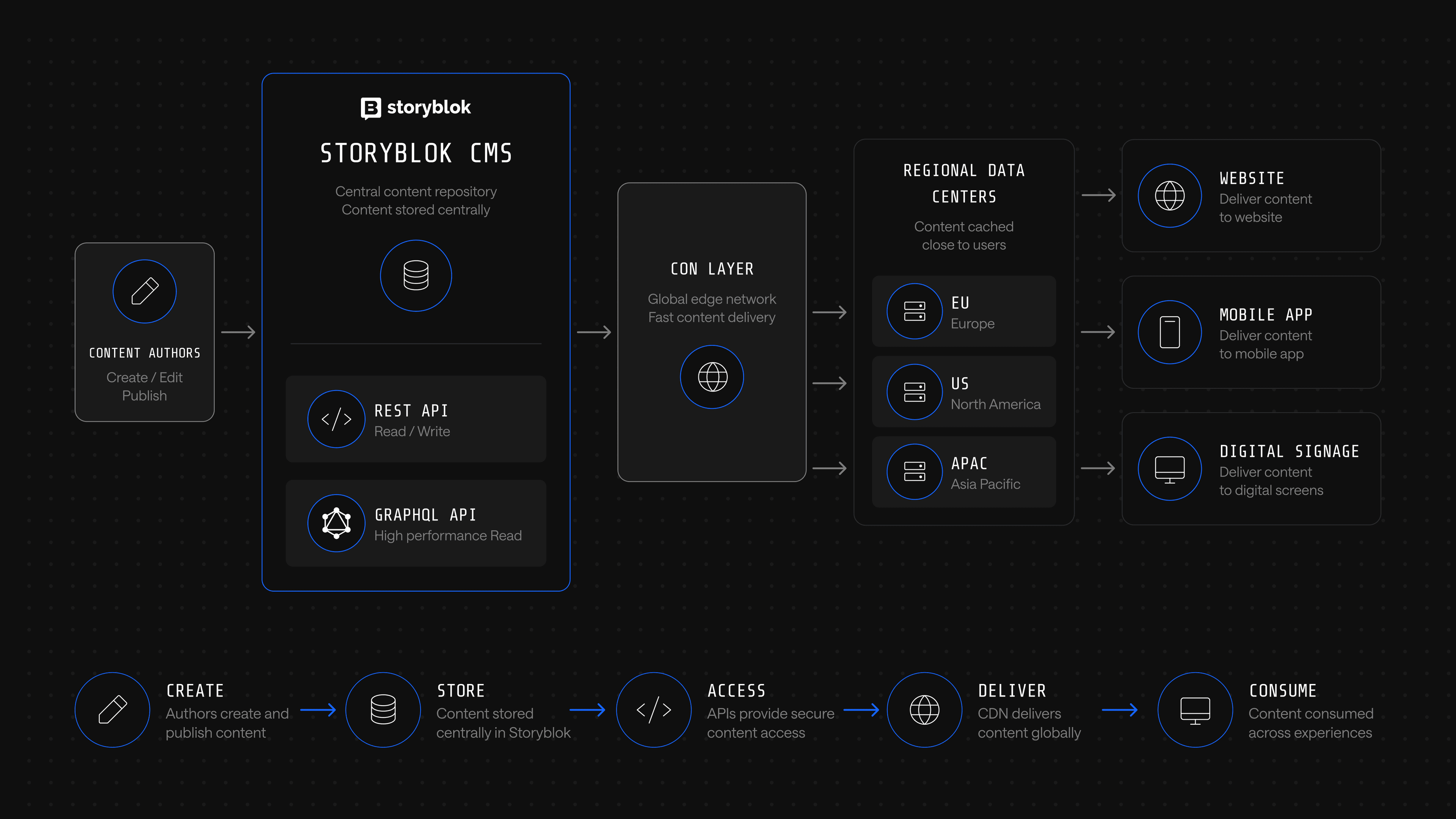
Storyblok operates on a cloud-native, API-first foundation. Content lives in a centralized repository and flows to any frontend through RESTful and GraphQL APIs. This decoupled approach means your website, mobile app and other applications can all pull from the same content source without duplication.
The platform runs on AWS infrastructure with a global content delivery network (CDN) for low-latency delivery. For enterprise deployments, Storyblok offers regional data center options across North America, Europe, Australia and China to address data sovereignty requirements.
The component-based content model distinguishes Storyblok from page-centric alternatives. Teams build with modular "Bloks" rather than monolithic pages:
- Content type blocks define complete structures like pages or articles.
- Nestable blocks serve as reusable elements such as calls-to-action or testimonial cards.
- Universal blocks provide flexible components usable across multiple contexts.
This architecture aligns with modern development practices while giving marketing teams flexibility within established guardrails. Developers build components once. Marketing teams assemble and update pages without opening a ticket.
The Visual Editor: Marketing Autonomy Without Developer Tickets
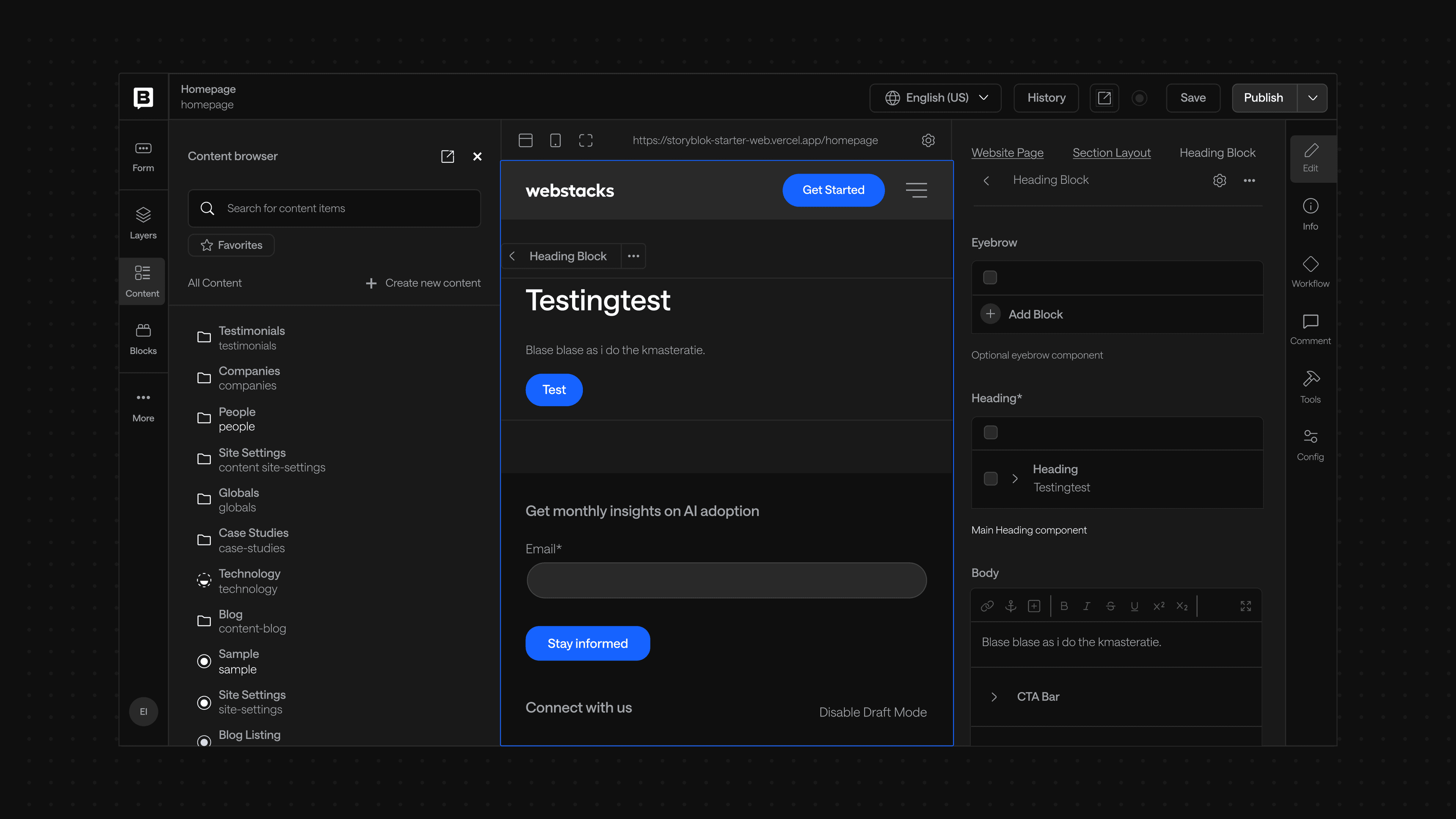
The visual editor is Storyblok's primary differentiator in the headless CMS market. Storyblok is the only major headless CMS that provides true visual editing with drag-and-drop Bloks architecture. Contentful, Sanity and Strapi all rely on form-based content editing, which requires developer support for layout changes and complex workflows.
Marketing teams can, without developer involvement:
- Click directly on any page element to edit content inline.
- Drag and drop components to build new pages from predefined blocks.
- Preview changes across desktop, tablet and mobile viewports simultaneously.
- Schedule content releases and manage approval workflows.
- Run A/B tests through the VWO plugin integration.
By cleanly separating responsibilities, developers can build components once and establish strict brand guardrails, giving marketing teams the freedom to mix, match, and customize content for campaigns without ever touching code.
This separation produces measurable outcomes. Spendesk, a B2B spend management platform, achieved an 80% faster page creation rate after migrating from HubSpot. Panini reduced time-to-market for new product pages from days to hours. For B2B teams where go-to-market velocity is a competitive lever, that delta is meaningful.
For a closer look at how it stack up against the competition, check out our headless CMS comparison below.
Storyblok AI and Content Automation
Storyblok has embedded AI capabilities directly into the platform, targeting the consistency and scale challenges that distributed marketing teams face. Regional teams interpreting guidelines differently, product divisions launching campaigns with divergent messaging and partner networks using outdated assets: these are the problems the AI layer is designed to reduce.
Storyblok provides five integrated AI capabilities:
- AI Translations support 30+ languages while maintaining brand voice across localized content, accessible through both the visual editor and API endpoints.
- AI Branding helps maintain brand voice consistency across multiple teams, languages and campaigns.
- AI SEO automates metadata generation.
- AI Alt Text generates accessibility-compliant alternative text through the Digital Asset Manager (DAM).
- AI Ideation provides content suggestions for topic consistency.
For enterprises with existing AI vendor relationships, Custom AI Tokens enable integration with OpenAI, Google Gemini, Perplexity and Claude using your own API credentials.
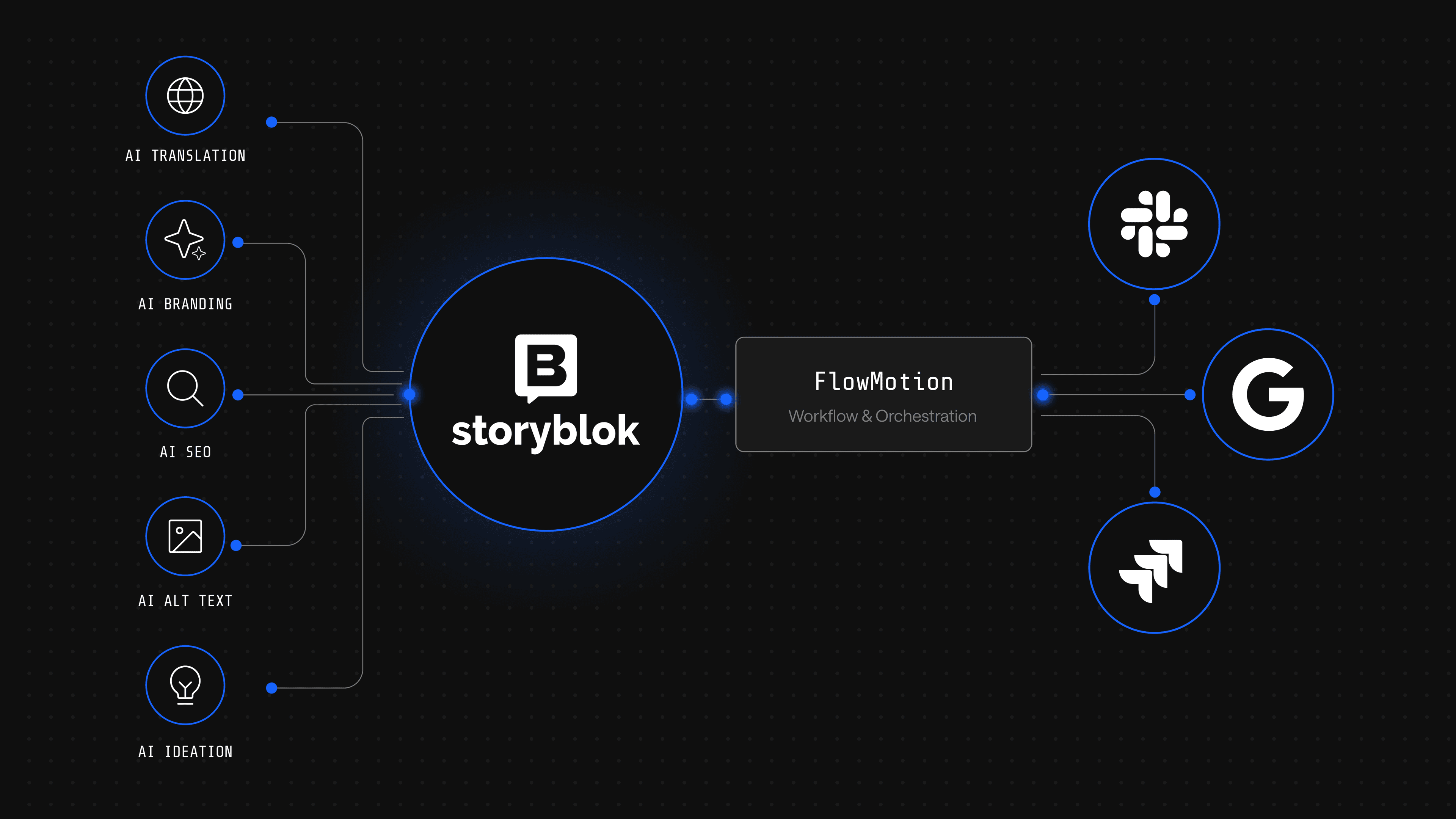
FlowMotion connects Storyblok to over 500 enterprise tools through an n8n integration, orchestrating AI agents to automate repetitive tasks. Specific automation capabilities include:
- Content approval routing based on content type or market.
- Automatic publishing triggers when all stakeholders sign off.
- Asset management workflows that ensure brand-approved images flow through the proper review channels.
The visual workflow designer allows non-technical users to configure these automations without developer involvement.
Strata, Storyblok's vector-based content understanding layer, analyzes content contextually and builds a vector database to enable personalization at scale. Unlike keyword-based systems, vector analysis understands semantic relationships between concepts, allowing Strata to identify content that drifts from brand voice even when using technically correct terminology.
For AI search optimization, this ensures that when tools like ChatGPT or Perplexity reference your content, they surface accurate and brand-consistent information.
Passing InfoSec: Storyblok’s Enterprise Security and Compliance
For B2B SaaS companies serving enterprise customers or preparing for IPO, Storyblok provides documented security infrastructure. The platform maintains ISO 27001 certification for information security management and SOC 2 Type 2 compliance covering all five Trust Service Criteria.
Compliance Frameworks
Storyblok maintains certifications across major regulatory frameworks:
- ISO 27001 and SOC 2 Type 2 certifications
- Full General Data Protection Regulation (GDPR) compliance with EU-based primary data hosting
- Health Insurance Portability and Accountability Act (HIPAA) standards for protected health information
- California Consumer Privacy Act (CCPA)/California Privacy Rights Act (CPRA) compliance, plus Virginia VCDPA, Colorado Privacy Act, Utah Consumer Privacy Act and Connecticut Data Privacy Act
- EU-U.S. Data Privacy Framework self-certification
- Austrian Data Protection Act compliance
Encryption and Authentication
The platform implements TLS 1.3 encryption for data in transit and AES-256 encryption at rest. Enterprise authentication includes mandatory two-factor authentication (2FA), Single Sign-On (SSO) integration via Security Assertion Markup Language (SAML), Auth0, Okta and Microsoft Entra ID.
Monitoring and Infrastructure
Storyblok provides enterprise-grade monitoring built on AWS:
- Comprehensive audit logs with extended retention periods on premium plans
- AI-powered anomaly detection
- Regular penetration testing
- Role-based access control (RBAC) with customizable roles
- AWS GuardDuty threat detection and Web Application Firewall (WAF) protection
Enterprise Service Level Agreements
Premium and Elite plans offer uptime SLAs of 99.9% and 99.99%, respectively, translating to maximum annual downtime of approximately 8.76 hours and 52.6 minutes per year. Enterprise tiers also include unlimited custom workflow stages, dedicated customer success managers, priority support response times, extended audit log retention and custom onboarding programs.
For organizations subject to their own customer SLAs, these guarantees can be built into service architecture with documented fallback procedures, which is typically a procurement requirement for enterprise vendor assessments.
Verified Results from B2B Implementations
When evaluating a new CMS, vendor case studies often promise unrealistic timelines. But the actual efficiency gains—when implemented correctly—are highly consistent across scaling digital teams.
On average, moving away from legacy, developer-dependent systems to a component-based headless architecture drives a 50–100% reduction in content production time.
Here is how those efficiency gains break down across actual implementations:
- Accelerated Content Operations: For scaling B2B SaaS teams like IT automation platform Automox, moving to Storyblok doubled content operations speed, cut resource center loading times by 50%, and allowed them to complete their full content migration in just one month.
- Instant Publishing at Scale: Large-scale digital migrations demonstrate how drastically localized publishing times drop. In enterprise environments, content update cycles have plummeted from 20 minutes per page down to instant publishing, drastically reducing engineering ticket volumes for routine changes.
- Streamlined Localization: For complex setups handling multiple languages and hundreds of external suppliers, shifting to a structured content model has compressed core content creation timelines down to six weeks, even when managing workflows across 12 separate languages.
Setting Realistic Timeline Expectations
While vendor case studies love to highlight rapid 1.5-to-3-month turnarounds, true B2B enterprise implementations require a more pragmatic roadmap.
If you are a scaling B2B organization with complex tech stacks, localized instances, or deep integration needs, expect a realistic timeline of 4 to 6 months. A successful deployment relies on dedicated developer resources and structured phases across discovery, component content modeling, migration, and team training.
Limitations and Considerations Before Adoption
Beyond the visual editing capabilities and enterprise certifications, Storyblok presents concrete operational challenges that B2B decision-makers should evaluate before committing. Procurement teams who overlook these factors often encounter unexpected costs, timeline delays or feature gaps that complicate post-implementation operations.
Enterprise Feature Gaps
According to verified Capterra reviews, Storyblok lacks native content block disabling, asset scheduling capabilities and user role customization beyond predefined options. Editors must delete blocks entirely rather than disabling them. Organizations with sophisticated governance requirements should conduct a detailed gap analysis.
Support Quality
Verified user reviews document slow response times and insufficient proactive guidance during implementation phases. For mission-critical applications, evaluate whether Storyblok's support SLAs meet incident response expectations during procurement, not after go-live.
Training Investment
Visual editing does not eliminate learning curves for complex content structures. Budget for comprehensive content team training. Teams typically take 2–4 months to reach pre-migration efficiency levels, even with structured onboarding.
Migrating to Storyblok
Most enterprise CMS migrations run into trouble because teams underestimate the gap between exporting content and actually running a new platform. Storyblok's component-based architecture requires a different mental model than traditional CMS platforms. In practice, migration becomes content transformation, and the technical work is only half of it.
Why Pre-Migration Planning Determines Everything
The discovery and architecture phases set the foundation for every decision that follows. A thorough content audit precedes all technical work and serves two purposes: it documents what you have, and it forces hard decisions about what actually deserves migration.
Quantitative audit work should capture total content items by type, media asset inventories with format specifications and metadata structure documentation. Qualitative ROT (Redundant, Outdated, Trivial) analysis often identifies a significant portion of legacy content that does not warrant migration. That prioritization reduces scope, timeline and cost.
Content modeling is the highest-risk phase. Storyblok's component-based architecture differs from traditional page-based platforms; poorly designed content schemas create technical debt that can hinder scalability for years.
A WordPress "Blog Post" content type typically becomes multiple reusable components in Storyblok, including a BlogPost component for structure and smaller components for calls-to-action or embedded media. Budget for dedicated content strategist resources during this phase. The architecture that enables long-term marketing autonomy does not happen by accident.
The Migration Process
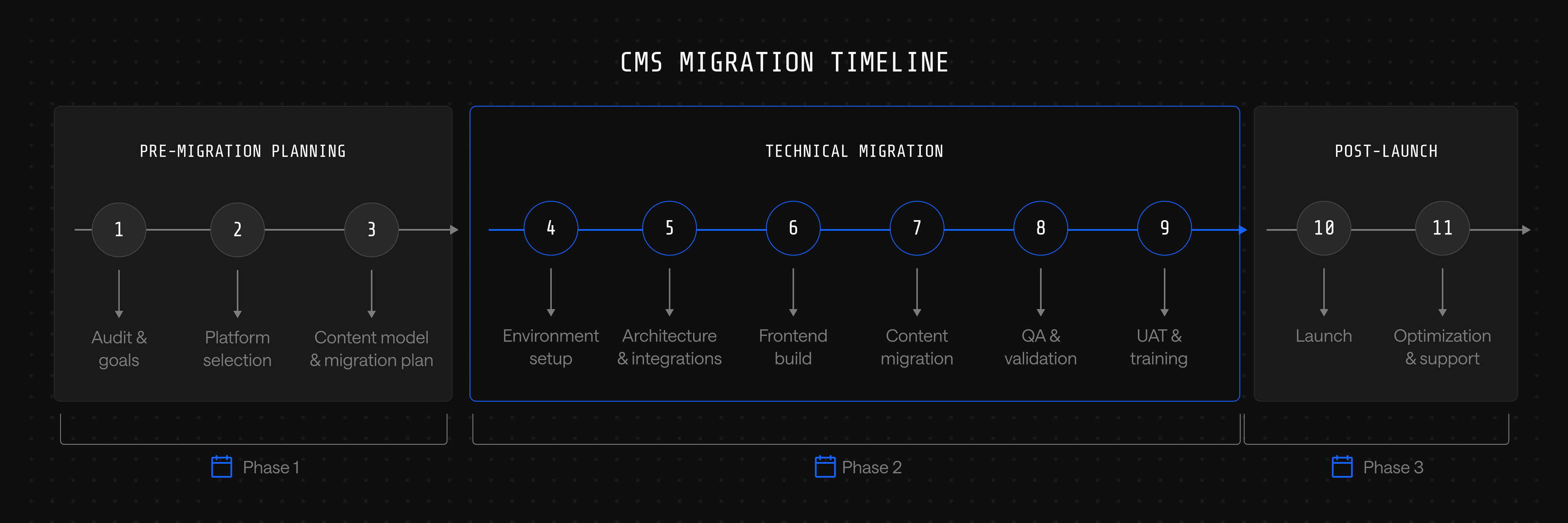
Enterprise migrations follow a structured sequence across eleven phases. The first three, Discovery, Architecture Design and Content Export, are foundational and should be complete before any technical migration work begins. Rushing these is how teams end up restructuring components mid-import or discovering missing content types after cutover.
The remaining phases handle the technical migration:
- Content Transformation converts exported content into Storyblok's JSON format and maps fields from legacy schemas to new component structures. Custom scripting using the Storyblok CLI handles automated processing at scale.
- Asset Migration uploads media files to Storyblok's native DAM and updates all asset references to new URLs. For B2B SaaS companies with large screenshot libraries and product imagery, this phase typically takes longer than estimated.
- Content Import executes bulk imports through the Management API. The API enforces rate limits, so plan for staged batches with retry logic. Use a two-pass import approach: the first pass creates all stories, and the second establishes relationships between them.
- SEO and URL Management preserve organic performance through 301 redirects and metadata parity. Headless CMS setups do not handle routing automatically. Commission a complete URL inventory before migration begins, allocate dedicated SEO specialist time and run a crawl on staging and again immediately post-cutover.
- Integration Reconstruction rebuilds connections between Storyblok, your frontend and your martech stack. Storyblok does not include built-in form functionality or native CRM connectors. Integrations with HubSpot, Marketo or Salesforce require custom development or middleware tools such as n8n or Pipedream. Scope each integration individually and treat this phase as engineering work, not a vendor marketplace line item.
Realistic Timelines
A small website migration may take a few weeks. A large enterprise migration with multiple stakeholders, languages and integrations commonly runs 3–6 months or longer. The Spendesk team migrated 1,000+ blog posts in 90 days. The CAVU implementation delivered 11,280 pages across five brands in 12 months. Timelines scale non-linearly with complexity; more people rarely fix it, because coordination and validation overhead grow faster than delivery capacity.
Post-Migration Governance
Migration completion is not project completion. Establish baseline performance monitoring across API response times, page load speeds and error rates from day one. Content governance must address editorial guidelines, approval workflows, role-based permissions and version control. Implementing website governance early prevents the sprawl that undermines performance and slows publishing at scale.
For the full migration playbook, see Storyblok Migration Guide: Step-by-Step Process.
Working with a Storyblok Agency Partner
Organizational readiness and strategic alignment determine implementation outcomes more than platform capabilities. That pattern applies directly to Storyblok: the right agency partner does not just build components; it establishes the content architecture, governance model and internal adoption framework that determine whether marketing autonomy is real after launch, not just theoretical.
What Agency Partners Deliver
Agency partnerships provide value across four core service categories.
- Strategic consulting covers digital maturity assessments, composable architecture design for complex B2B tech stacks, phased transformation roadmaps and stakeholder alignment frameworks that surface potential barriers before they derail projects.
- Technical implementation builds custom components tailored to your content types, configures the visual editor for your specific workflows and establishes the frontend architecture that delivers content to your digital properties. Agencies accelerate implementation through pre-validated integration patterns for CRM connections, marketing automation synchronization and e-commerce platform integrations refined across multiple projects.
- Content migration and governance design content models for scalability and reusability rather than replicating legacy structures. This includes reusable component architecture, multi-language structure for global operations, personalization frameworks for account-based content delivery and design system integration for visual consistency.
- Post-launch technical support covers platform updates, security vulnerability patching, feature releases and continuous testing. Support costs vary based on scope, response-time requirements and optimization intensity: request itemized proposals during evaluation.
Agency Selection Criteria
When evaluating Storyblok agency partners, request technical architecture documentation from 2–3 comparable implementations, including system integration diagrams and performance metrics. Verify enterprise experience through documented project outcomes with quantifiable results from companies in your revenue range.
Verify the agency's experience with your specific martech platforms (Salesforce, HubSpot, Marketo or Pardot) through technical architecture reviews that demonstrate API integration patterns, not generic capability claims. Integration requirements consistently emerge as the primary cost and timeline driver; they require detailed scoping estimates for your specific stack.
Contract protections worth negotiating include multi-year pricing locks, clear code IP ownership documentation, GDPR-compliant data handling agreements and performance guarantees tied to Google's Core Web Vitals thresholds. Define maximum acceptable page load times in agency contracts before work begins.
For the full agency partner evaluation framework, check out our deep-dive guide: Working with a Storyblok Agency: What B2B Companies Should Know.
Storyblok development for fast-moving teams—streamlining your dev, design, and marketing operations.

How Storyblok Compares to Alternatives
The headless CMS market forces a core tradeoff: marketing velocity versus enterprise governance. Platforms like Storyblok optimize for marketing autonomy through visual editing. Enterprise-focused platforms like Contentful optimize for governance through granular permissions, comprehensive audit trails and advanced workflow controls.
Most organizations need both. The question is which constraint is more painful to work around: building custom governance on a marketing-optimized platform, or accepting slower velocity on an enterprise-optimized one. Here is how the most common alternatives stack up, with full comparisons linked for teams deeper in the evaluation process.
- Storyblok vs. Contentful: Contentful offers more mature enterprise infrastructure with a 99.99% uptime SLA, comprehensive RBAC and extensive audit trails, and is a Forrester Strong Performer in the CMS Wave. However, Contentful relies on form-based editing that maintains developer dependency for layout changes. Choose Contentful when compliance requirements and enterprise-scale governance are non-negotiable. Choose Storyblok when marketing autonomy and content velocity are the primary constraints.
- Storyblok vs. Sanity: Sanity provides maximum developer customization through its React-based studio and GROQ query language. It lacks a true built-in visual editor, which means marketing teams need developer support for content model changes. Best for engineering-led organizations that prioritize customization over marketing self-service.
- Storyblok vs. WordPress: WordPress offers a large plugin ecosystem and broad developer familiarity, but its monolithic architecture accumulates technical debt at scale. Storyblok's headless approach separates content from presentation, enabling faster frontends and greater content reuse across channels.
- Storyblok vs. DatoCMS: DatoCMS is a developer-friendly, API-first platform with a clean content modeling experience. It lacks Storyblok's visual editor depth, which limits marketing team independence for page assembly. Best for teams that prioritize structured content modeling over visual editing.
- Storyblok vs. Prismic: Prismic's Slice Machine gives marketing teams reusable content components to assemble, closer to Storyblok's model but with less visual editing depth. A reasonable middle ground for teams wanting structured components with more developer control than a fully visual editor approach.
- Storyblok vs. Strapi: Strapi is an open-source framework that gives engineering teams full control over architecture and deployment, but self-hosting shifts infrastructure, security patching and scaling to your internal team. Best for organizations with dedicated DevOps capacity that need data sovereignty or open-source cost control.
- Storyblok vs. Webflow: Webflow prioritizes visual design autonomy with its no-code builder, but its CMS capabilities are limited for complex B2B content operations. Storyblok is the stronger choice for organizations managing large content volumes, multi-language sites or API-driven content delivery across multiple channels.
Both Storyblok and Contentful exhibit high migration complexity due to proprietary content models and schema dependencies. Migration difficulty increases substantially with time invested in either platform, which is why platform selection deserves structured evaluation before commitment.
Making the Right Platform Decision
Storyblok solves a specific problem well: eliminating developer bottlenecks for marketing content operations through genuine visual editing. Storyblok reports measurable efficiency gains, including a 50% increase in content operations speed, up to 70% reductions in website development time, and a 3x productivity boost in a Forrester Total Economic Impact study.The AI layer, workflow automation through FlowMotion and vector-based personalization through Strata extend that advantage into content at scale.
The tradeoffs are real and worth planning for. Enterprise feature gaps and variable support quality are known friction points that require careful procurement evaluation, not post-commitment discovery.
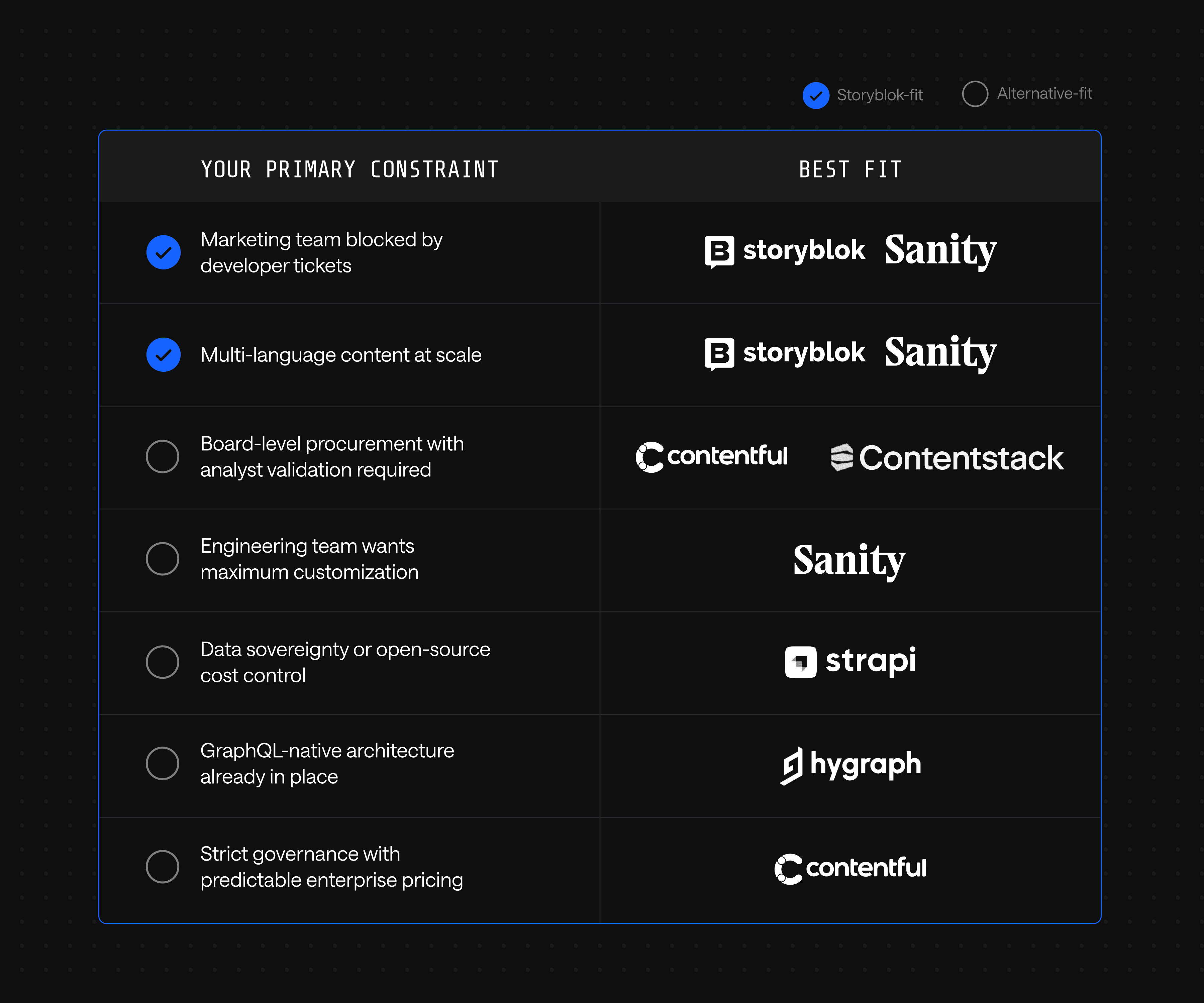
Use this decision matrix to identify your fit:
| Your primary constraint | Best fit |
|---|---|
| Marketing team blocked by developer tickets | Storyblok |
| Multi-language content at scale | Storyblok |
| Board-level procurement with analyst validation required | Contentful or Contentstack |
| Engineering team wants maximum customization | Sanity |
| Data sovereignty or open-source cost control | Strapi |
| GraphQL-native architecture already in place | Hygraph |
| Strict governance with predictable enterprise pricing | Contentful |
Storyblok fits when marketing velocity is the primary constraint, your team can accommodate budget flexibility and you have developer resources for the initial component buildout.
Evaluate alternatives when strict governance requirements, predictable long-term pricing or advanced user role customization are non-negotiable, particularly for organizations approaching IPO or operating under stringent compliance mandates.
The right choice depends on whether your primary constraint is marketing execution speed or enterprise infrastructure maturity. Webstacks implements composable architecture using Storyblok, Contentful, Sanity and other headless CMS platforms for B2B SaaS companies scaling toward enterprise. As a Storyblok partner, we have deep experience maximizing the platform's capabilities and can help teams evaluate alternatives when specific requirements call for it.
Talk to Webstacks about evaluating headless CMS options and implementing composable architecture that gives your marketing team autonomy without sacrificing enterprise-grade performance.

Your website is your biggest growth lever—are you getting the most out of it? Schedule a strategy call with Webstacks to uncover conversion roadblocks, explore high-impact improvements, and see how our team can help you accelerate growth.