The SaaS Pricing Page Playbook: Practices and Real Examples

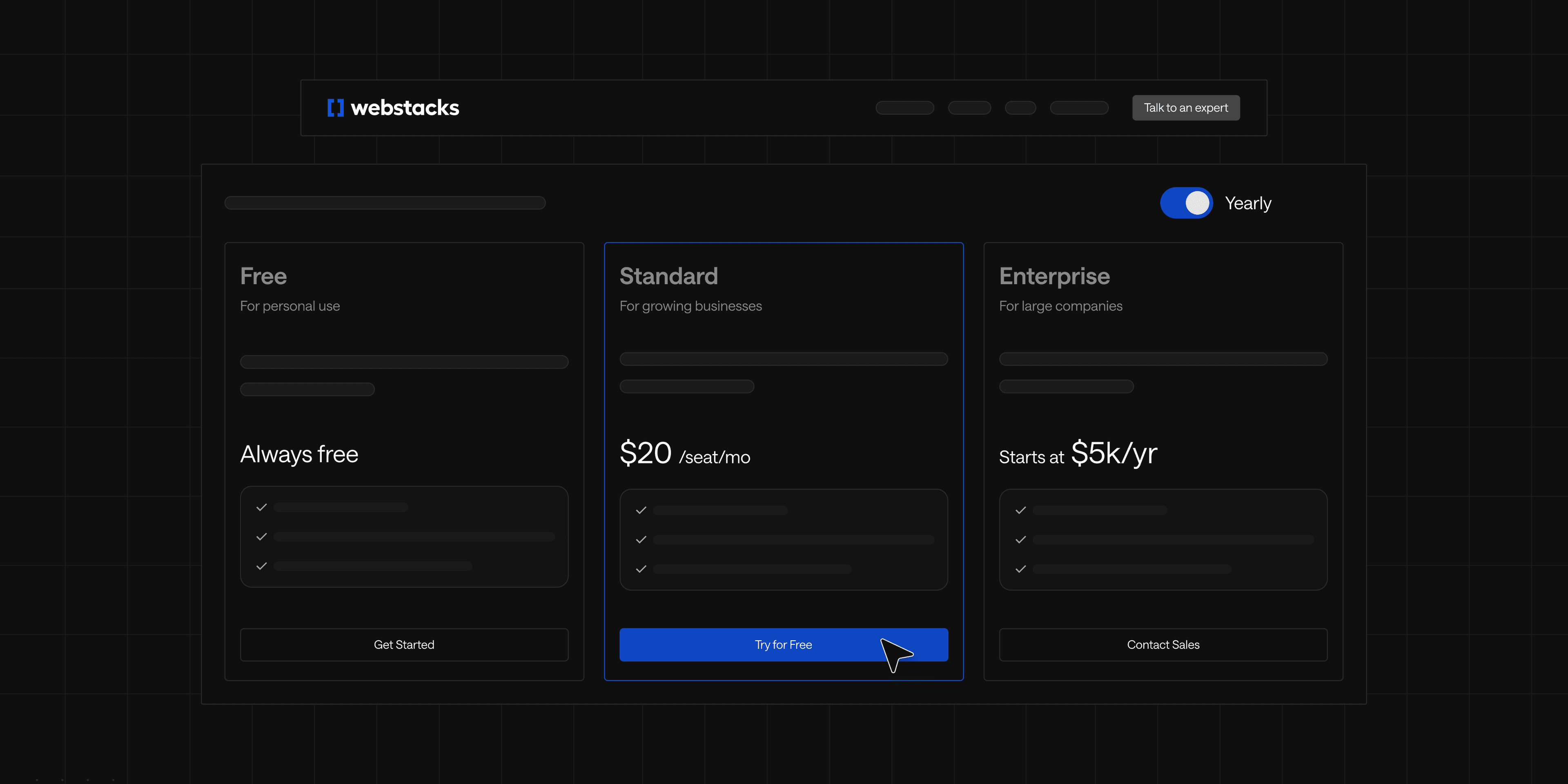
Your pricing page is one of the most-visited parts of your website. It's where most prospects go before they convert, whether your buyer is a self-serve individual contributor or a six-person committee, so it needs to be clear, helpful, and easy to use for whichever audience you're actually selling to.
That pressure has only grown. According to Gartner research, 67% of B2B buyers prefer a rep-free buying experience, which means your pricing page often does the selling before a sales rep ever gets involved, even when the deal ultimately closes through one.
But designing a pricing page that works isn't always straightforward.
Every product has its quirks, and your pricing model may not fit into a standard layout. AI adds another layer of complexity. Credits, agent hours, and usage-based AI features show up as line items across nearly every pricing page we looked at for this piece, which means the page has to communicate two pricing logics at once: tiers or seats, and consumption.
That second layer is often the harder one for a buyer to model, whatever segment they're in, and the pages that explain it clearly have a real advantage in the evaluation.
The strongest SaaS pricing pages pair clear UX with pricing tables that are easy to compare, whatever the underlying model, and give the buyer a credible path from "interested" to "ready to act," whether that action is a self-serve signup or a sales conversation.
SaaS pricing page best practices
Great SaaS pricing pages help potential customers compare plans and decide on the next step, so every element below should move prospects closer to a decision, whatever segment those prospects sit in.
Exceptional design layout
Organize pricing page information so it is easy to follow, with the pricing table itself as the priority. Pricing tables work best in a column format and should fit above the fold when the plan set allows. If your top tier is sold to large accounts with a long feature list, expect that tier to push the table wider than a typical three-column layout, and design for that case rather than letting it become an afterthought.
Headlines
Support your value proposition and entice potential customers to continue exploring. The headline should also set expectations about who the page is for: a phrase like "built for growing teams" signals fit to a mid-market buyer just as clearly as it signals a mismatch to an enterprise one, so choose the framing deliberately based on who you're actually trying to convert.
Pricing tiers
Each tier should identify a target market and clearly articulate its value. If you sell into larger accounts, your top tier needs to do more than list extra features; it should signal the governance, security, and support depth (SSO, SCIM, audit logs, dedicated account management) that a procurement review will ask about directly. If your buyer is closer to self-serve, that same tier should instead emphasize speed to value and predictable cost.
Free options or sandbox access
Consider giving potential customers the option to sign up for your offerings before sending any payment. A trial or limited free tier reduces hesitancy and can boost your conversion rate, even for products that ultimately close through a sales conversation rather than a self-serve checkout. Letting a technical evaluator test the product ahead of a broader review reduces friction later in the cycle.
Toggles/Tabs
Allow users to quickly switch between options if your pricing model is more complex. This matters whether the complexity comes from deployment choices (cloud versus self-hosted), billing cadence (monthly versus annual), or simply having enough plans that a flat list would overwhelm the page.
Tooltips
Keep lower-priority details available without crowding the main page. This matters most when a tier carries a long list of qualifiers, compliance certifications, usage limits, and add-on costs that would otherwise turn a clean table into a wall of text regardless of which segment that tier is aimed at.
Call-to-action (CTA) buttons
CTAs should directly assist and influence potential customers' decision-making, whether that is to learn more, talk to a sales rep, or make a purchase. Match the CTA to how that tier is actually sold: a self-serve tier should let someone start immediately, and a tier that always closes through sales should say so plainly rather than funneling everyone into a free trial first.
FAQ sections
Address recurring questions that potential customers may have. The more informed and confident a user is in your services, the better. The right questions to answer depend on your buyer: a self-serve audience needs billing mechanics and usage-limit specifics, while a buyer evaluating a larger commitment needs implementation, contract, and support questions answered just as directly.
Trust signals
A tried and true method for generating more leads is increasing your credibility. Add trust signals, testimonials, or customer reviews. Choose the signal that matches the buyer: star ratings and review counts build trust with a self-serve audience, while named security certifications and recognizable large-account customer logos do more work with a buyer further up the org chart.
Transparent pricing vs. hidden pricing
Every SaaS company has to decide how much pricing to show, and the right answer depends heavily on who's buying. Transparency helps convert self-serve buyers. For standard plans, lead with clear pricing so self-directed buyers can qualify themselves. Custom pricing still has its place. Reserve "Contact Sales" for tiers where deals are complex, onboarding is heavy, or the buyer expects a negotiated relationship regardless of company size.
This split is visible across the examples below. Aircall, Retool, Netlify, and Customer.io publish exact numbers for their entry tiers and reserve custom quotes for the top of the stack, a structure that works whether the top tier is sold to a 50-person company or a Fortune 500 one.
Chili Piper has moved the opposite direction, gating most of its pricing behind a sales conversation as its product has grown more complex. Neither approach is wrong on its own. The decision should follow from how the deal actually closes for that tier, not from an assumption that bigger buyers always need a hidden price.
SaaS pricing page examples
The companies below sell into very different segments, from individual users to global enterprises, and that range is the point. Whatever audience your pricing page needs to serve, the design patterns here carry over across segments, even when the underlying product doesn't. Each section below calls out what the page does well and who that specific choice is built for.
1. Aircall
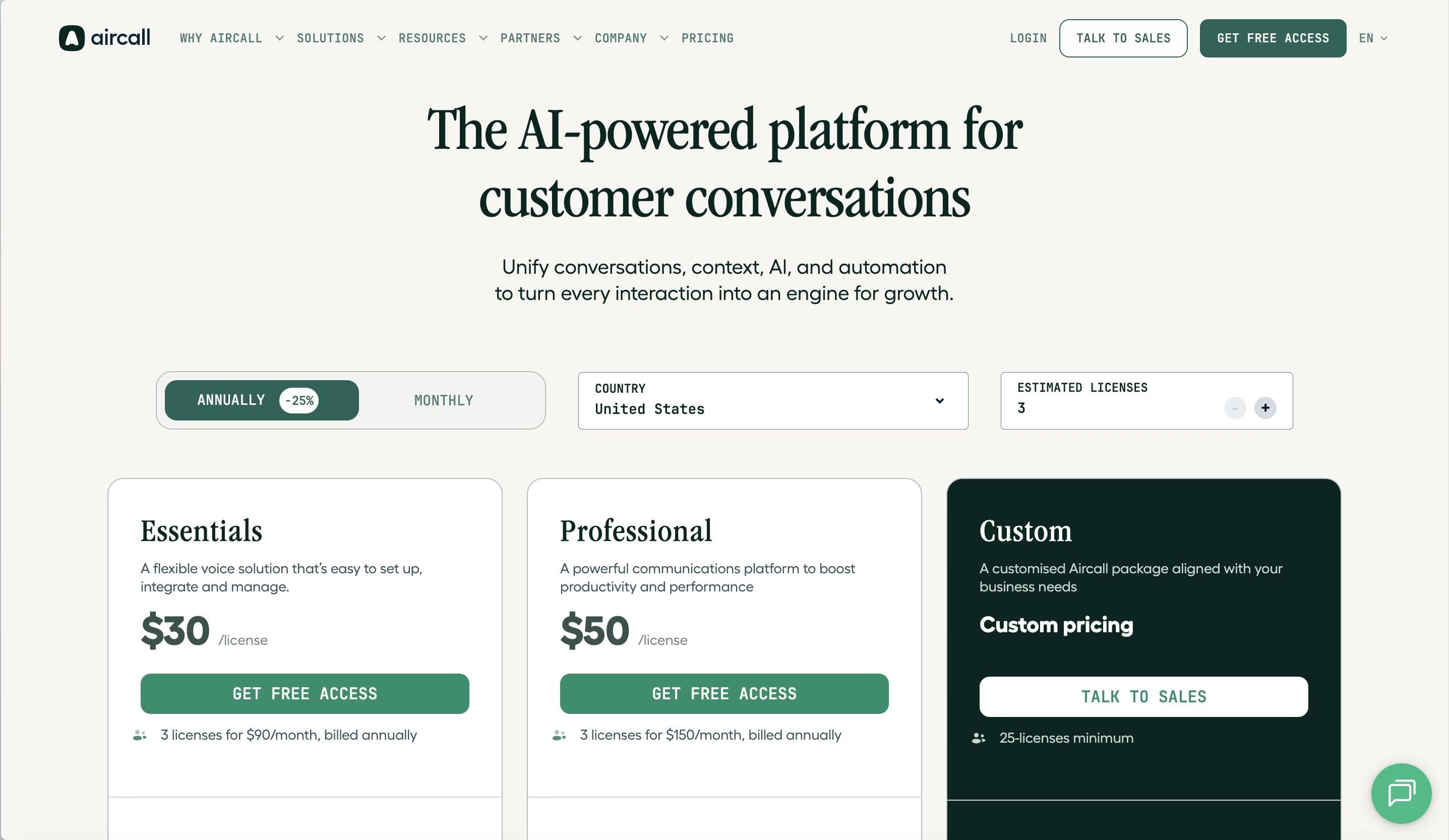
Aircall organizes its core plans into a clean three-tier structure (Essentials, Professional, and a 25-seat-minimum Custom tier), with controls that let buyers filter by country and license count before committing to a plan.
Alongside the three core tiers, Aircall sells a full AI product line. AI Voice Agents are billed by the minute, AI Messaging Agents are billed per conversation with a free monthly allotment, and AI Assist is billed per license per month. Each of these sits above the three core tiers as its own row with its own calculator-style pricing, so the page communicates two systems at once: seat-based tiers for the phone product, and usage-based pricing for the AI layer.
SaaS Pricing Page Design Choices We Love From Aircall:
- Tier filters that let buyers narrow by country and license count before seeing a quote
- AI products priced and explained separately from the core plans, so usage-based costs aren't buried in a footnote
- Detailed feature comparison table with category headers (work orders, analytics, integrations)
- G2, Capterra, and Reviews.io ratings surfaced directly in the pricing flow
2. Retool
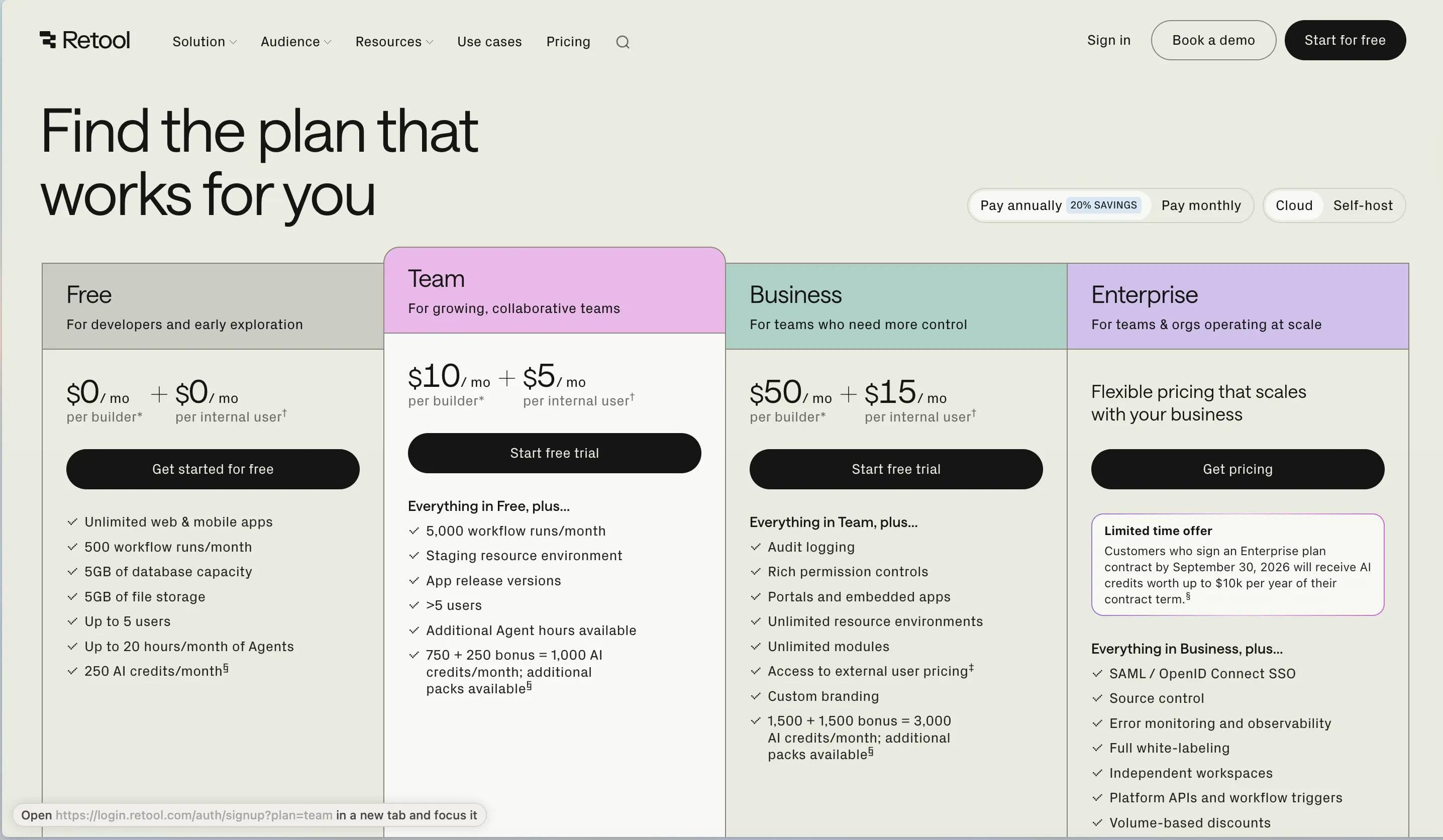
Retool has rebuilt its pricing around AI credits as the primary differentiator between tiers, not just feature gates. Free, Team, and Business plans each include a monthly credit allotment that scales with the per-builder price, and credits are explicitly described as the currency for both app generation and AI Actions.
This consumption model layers on top of seat pricing rather than replacing it. The "Cloud / Self Hosted" toggle gives technical buyers a real deployment decision to make, and credits remain the headline differentiator between tiers. Retool also sells a separate hourly-billed "Agents" product that lives outside the credit pool entirely, billed by the hour of agent runtime rather than by credit, adding a third pricing dimension alongside seats and credits.
SaaS Pricing Page Design Choices We Love From Retool:
- AI credit allotments shown inline with each tier instead of as a hidden usage meter
- Cloud/Self-hosted toggle that respects a real technical decision rather than treating it as a marketing lever
- Separate, clearly labeled pricing for Agents (hourly) versus standard app building (credits)
- Feature comparison table organized by buyer role (builder vs. internal user vs. external user)
3. Gusto

Gusto organizes its pricing around four tiers: Contractor Only, Simple, Plus, and Premium, each combining a flat monthly base fee with a per-person fee. Plus carries the "Best Value" badge, a notable choice since Premium is the most expensive tier on the page.
A large add-on marketplace sits beneath the core tiers. Gusto sells global contractor payments, state tax registration, R&D tax credit scanning, instant and same-day pay, and several HR and benefits add-ons, each with its own line-item price. The structure asks a buyer to pick a tier, then build out their own stack from there, which is a heavier cognitive load up front but gives Gusto more places to capture incremental revenue from a single account.
SaaS Pricing Page Design Choices We Love From Gusto:
- Limited-time promotional pricing on the entry tier, clearly labeled and time-boxed
- Add-on marketplace organized by category (payroll, HR tools, health benefits, money management, tax-advantaged benefits)
- Trust badges (FastCompany, Capterra, business.com) placed directly beneath the pricing table
- Extensive FAQ section that answers billing mechanics (contractor billing, mid-year switches, plan changes) before a buyer has to ask sales
If you sell into larger accounts: the add-on marketplace structure is the transferable idea here. Letting buyers see exactly what a capability costs as a standalone module, rather than forcing them into a bundled top tier to get one feature they need, gives a buyer's finance team a cleaner way to model incremental cost during a renewal or expansion negotiation.
4. UpKeep
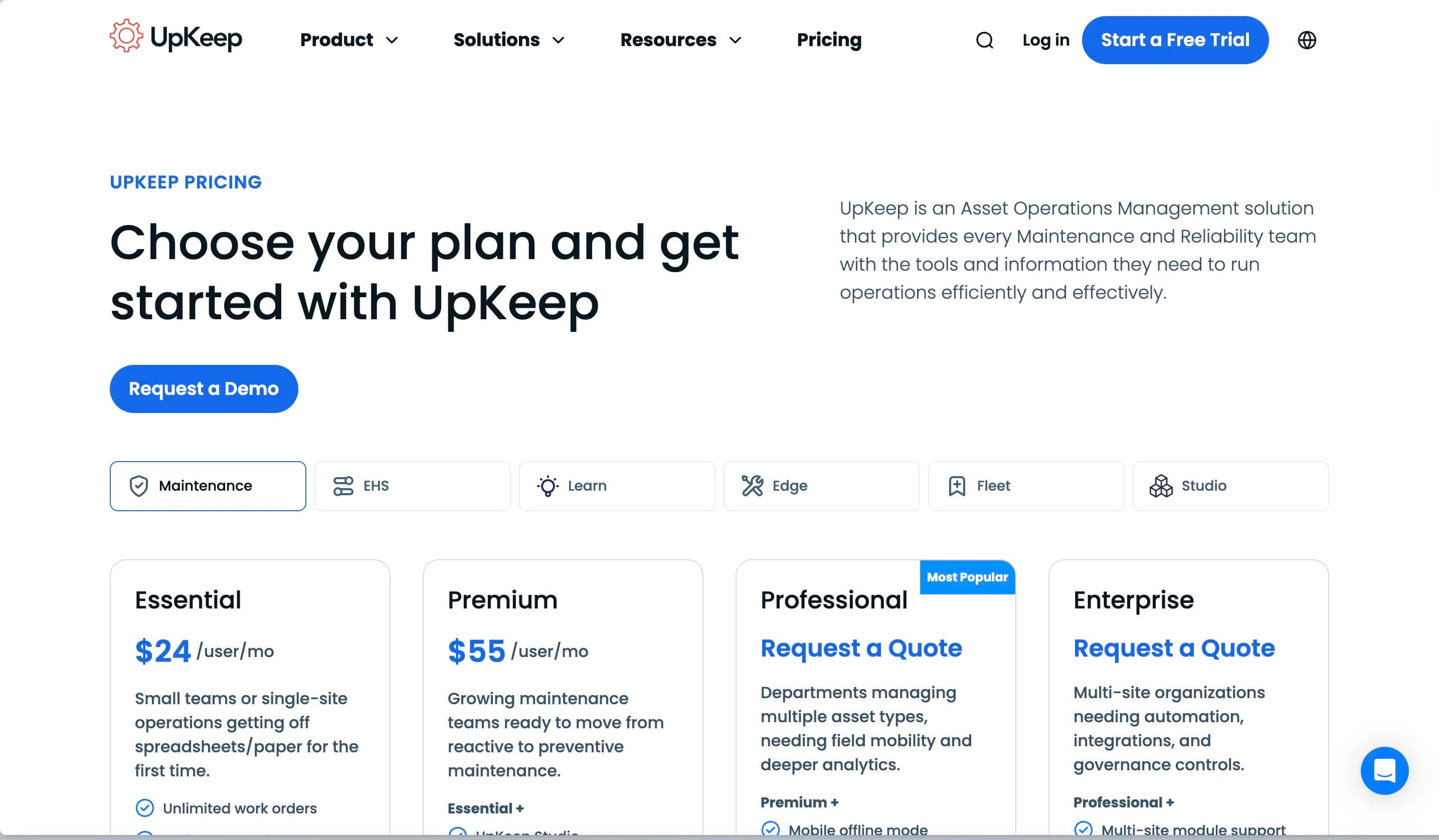
UpKeep organizes its tiers as Essential, Premium, Professional, and Enterprise. The "most popular" label sits on Professional, a custom-quote tier, rather than on a self-serve plan with a published price.
Nova, UpKeep's AI assistant, appears as a named feature across every tier rather than as an add-on. Upkeep also sells a separate EHS (Environment, Health, and Safety) product line with its own flat pricing and unlimited requester access, positioned as usable independently of the core maintenance platform. The detailed feature comparison table beneath the main cards covers work orders, asset management, mobile offline capability, and analytics depth by tier.
SaaS Pricing Page Design Choices We Love From UpKeep:
- AI assistant (Nova) named and positioned as a baseline feature, not an upsell
- Standalone EHS product with its own pricing, clearly separated from the core CMMS plans
- Granular feature comparison table that breaks capabilities down by category instead of a flat feature list
- FAQ section addressing free user types (view-only, requester, third-party) separately from paid user types
5. Chili Piper

Chili Piper sells a three-tier annual platform: Routing & Scheduling, Experiences, and a forthcoming Chili Data Platform. The entry tier starts at $15,000 per year with 15 seats included.
Each tier includes an annual AI credit allotment, and the page features a live pricing calculator that lets buyers adjust seat count and contract length to see real-time savings from multi-year commitments. The page leans on tier-level outcomes (pipeline lift, no-show reduction) rather than individual product features, which frames the buyer conversation around ROI rather than feature checklists.
SaaS Pricing Page Design Choices We Love From Chili Piper:
- Live calculator showing real-time pricing across seat count and contract length
- Annual AI credit allotments disclosed per tier rather than buried in fine print
- Outcome-based proof points (10 to 15% revenue increase, 70% instant conversion, 50%+ no-show reduction) placed directly in the pricing flow
- Detailed feature comparison table organized by capability area (routing, web experiences, AI agents, integrations, governance)
6. Amplemarket

Amplemarket uses a three-tier structure (Startup, Growth, Elite) built around team-size framing, set against a light-background feature comparison table and an extensive customer logo and testimonial section that runs the length of the page.
Amplemarket leads with migration proof. Customer logos are labeled by what they switched from ("Migrated off Apollo," "Migrated off Outreach + Seamless"), which turns the trust section into a direct competitive argument rather than generic social proof.
SaaS Pricing Page Design Choices We Love From Amplemarket:
- Migration-labeled customer logos that double as competitive displacement proof
- Tier names that map to team maturity rather than arbitrary plan letters
- Detailed line-item comparison table covering credits, contacts, and mailbox allotments by tier
- Custom pricing on higher tiers paired with a clear "Select plan" path rather than a hard contact-sales wall
7. Vercel
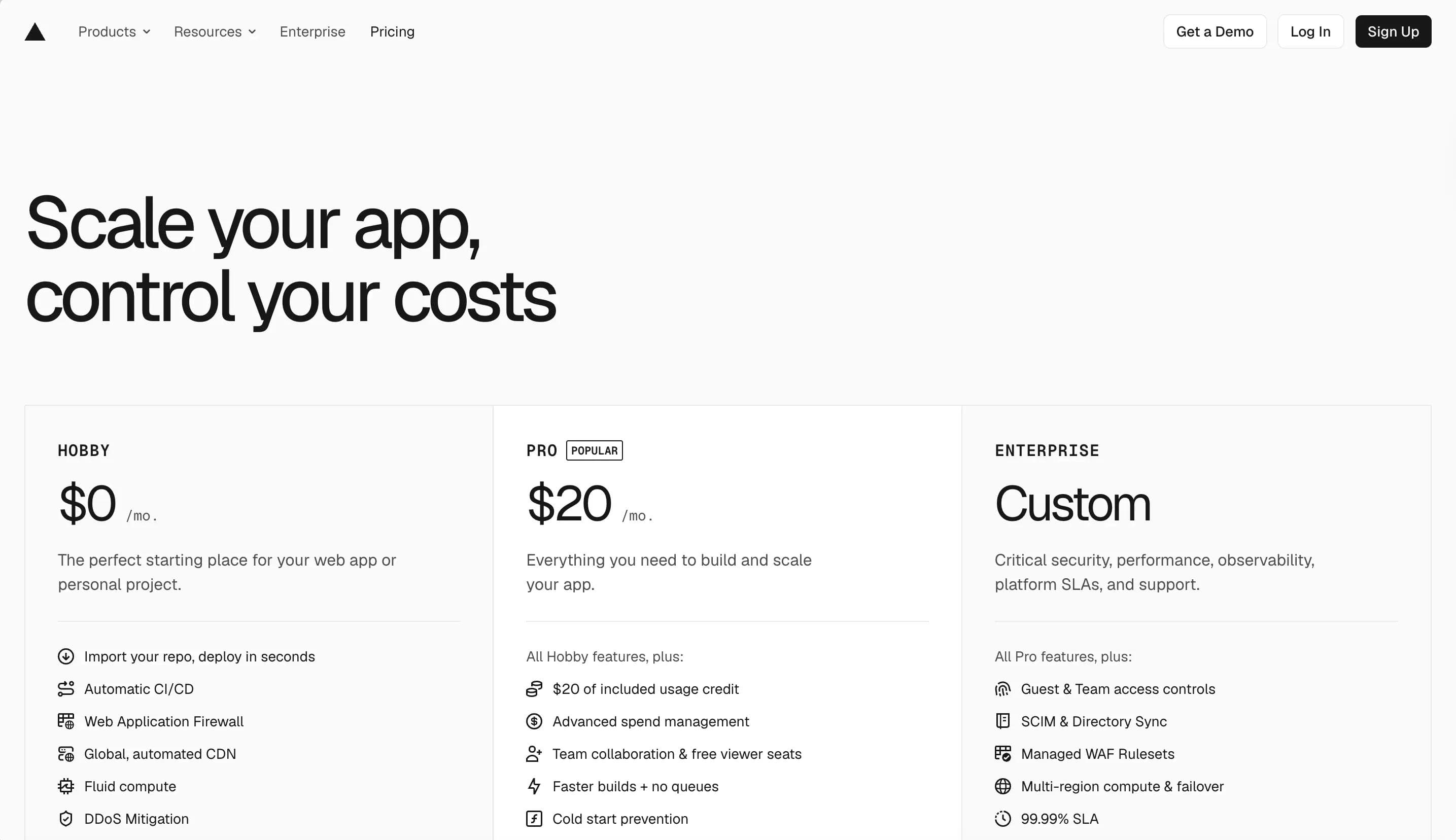
Vercel's pricing page sits on top of a Hobby/Pro/Enterprise tier structure but is built around a granular, usage-based rate card covering dozens of line items: edge requests, fast data transfer, compute (with Active CPU pricing for Fluid compute), AI Gateway, Vercel Agent, sandboxes, and microfrontends, among others. The three tiers function as an entry point into a detailed consumption model rather than as the full pricing story on their own.
The sticky-header feature comparison table is useful for scanning categories, including a dedicated "AI Cloud" section. For a developer audience, this is the correct level of detail. For a buyer comparing pricing pages at a glance, it is a dense page, which makes the sticky headers and clear visual hierarchy especially important.
SaaS Pricing Page Design Choices We Love From Vercel:
- Sticky category headers that keep long usage tables navigable
- A dedicated AI Cloud section breaking out Agent, Gateway, and Connect pricing separately from core compute
- Spend management controls (budgets, alerts, hard limits) explained inline rather than only in docs
- Security and compliance rows (SAML SSO, directory sync, custom firewall rule counts, named certifications like SOC 2, PCI DSS, ISO 27001, HIPAA BAA) broken out by tier with specific limits, giving a security reviewer a checklist instead of a sales call
- Clear visual hierarchy that still draws the eye to the Pro plan despite the added complexity
8. Slack

A strong SaaS pricing page example set should include a mobile layout, and Slack's underlying page is worth testing on mobile given how much detail it carries.
Slack organizes its tiers as Free, Pro, Business+, and Enterprise+, with the "Best value" label on Business+. The page is built around a dense feature-comparison table where AI capability is a primary axis, not a side mention: Slackbot (a personal AI agent), AI-generated daily recaps, AI search, and AI-powered workflow steps are each broken out by tier across a comparison table that spans collaboration, CRM, automation, security, compliance, and administration.
Mobile design matters here. Organizations often neglect the importance of user-friendly mobile design, and pricing pages are one of the hardest places to get this right given how dense Slack's comparison table is. DRIP's 2026 data from 486 million sessions shows that mobile accounts for 78% of e‑commerce traffic, delivering 49% of revenue. Treating mobile pricing and checkout as a first‑class revenue channel, not a scaled‑down desktop layout, has a direct impact on how much of that mobile demand a business actually converts.
SaaS Mobile Pricing Page Design Choices We Love From Slack:
- AI capability broken out as its own comparison category instead of folded into "collaboration"
- Tier renaming (Business+, Enterprise+) that signals AI maturity, not just seat count or support level
- FAQ addressing AI-specific concerns directly (data handling, LLM training, infrastructure location)
- Dual CTAs ("Get started" and "Talk to sales") on every tier, including the free plan
Enterprise+ is where this page does its real procurement work. The comparison table breaks out exactly what changes at that tier (multi-SAML, anomaly event response, legal holds, discovery API, custom terms of service), and Slack's explicit statement that customer data is never used to train its models, with infrastructure kept in Slack's own AWS VPC, is the kind of specific security claim a buyer's security review needs before sign-off, whatever size that buyer is.
9. PostHog
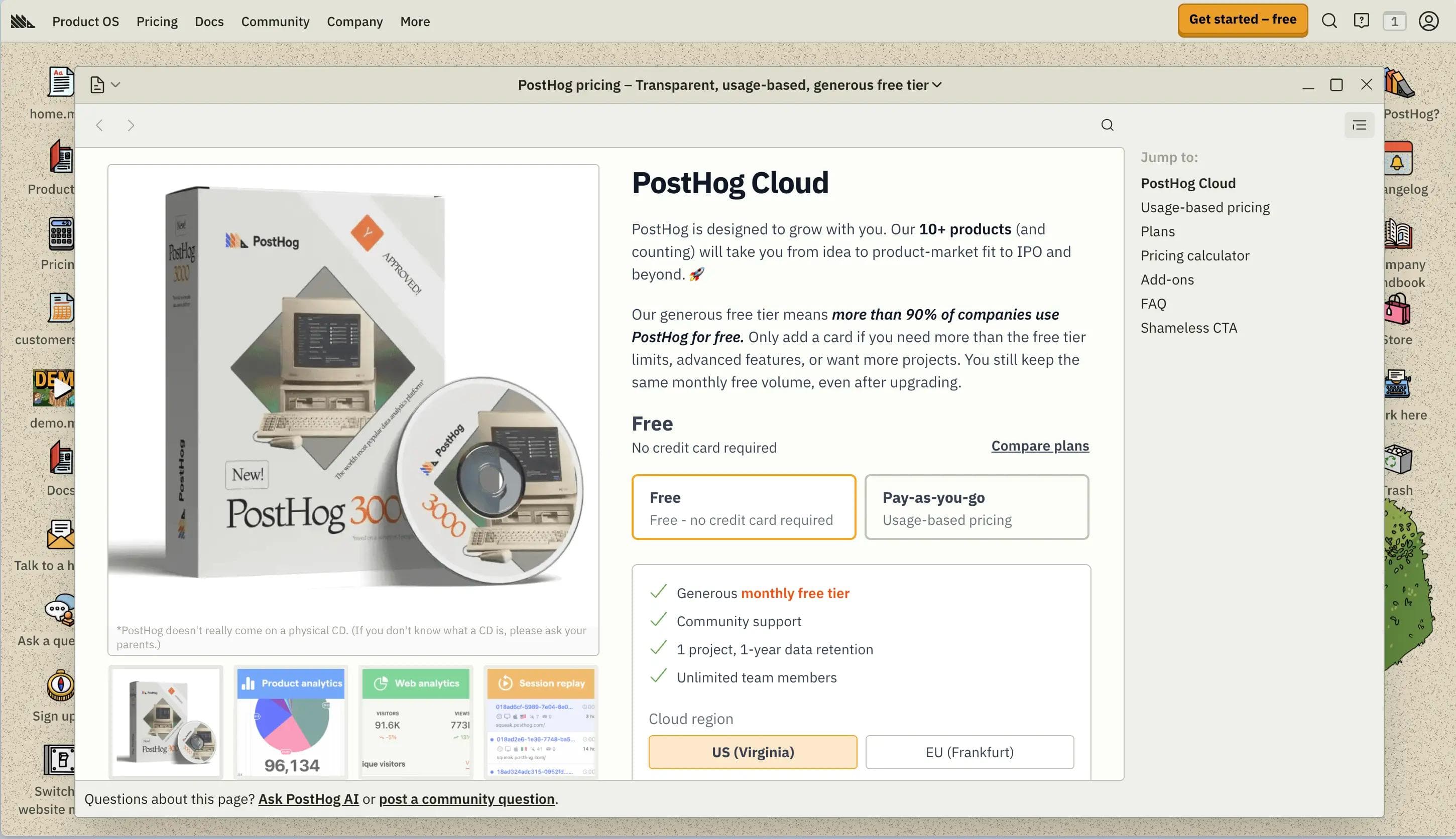
PostHog throws out the conventional SaaS pricing playbook.
PostHog runs on a Free and Pay-as-you-go structure, with per-product usage sliders and a live cost calculator that updates as you adjust volume across more than a dozen products (analytics, session replay, feature flags, surveys, data warehouse, error tracking, and more). The dark theme and playful copy carry through the whole page, down to the literal microcopy "This is the call to action," which sits on the page verbatim.
PostHog AI is its own metered product, billed per credit with a free monthly allotment, sitting alongside the other usage-based line items rather than replacing any of them. This is a clean example of adding an AI pricing dimension without disrupting an already-transparent usage model.
SaaS Pricing Page Design Choices We Love From PostHog:
- Fully interactive cost calculator with real-time pricing estimates across every product
- PostHog AI metered as its own line item without disturbing the existing usage-based logic
- Edgy, developer-first design that still feels approachable
- Smart copy that turns complexity into clarity, including a frequently-purchased-with section pairing PostHog with adjacent dev tools
If your buyer base spans segments: PostHog's platform packages (Boost, Scale, Enterprise) sit quietly below the calculator and give larger buyers a self-serve path into more advanced controls (RBAC, SSO enforcement, dedicated support) without forcing a sales call until the buyer is ready. That's a useful model for any company that wants to support both self-serve and larger accounts on the same page without splitting into two separate pricing experiences.
10. Tines
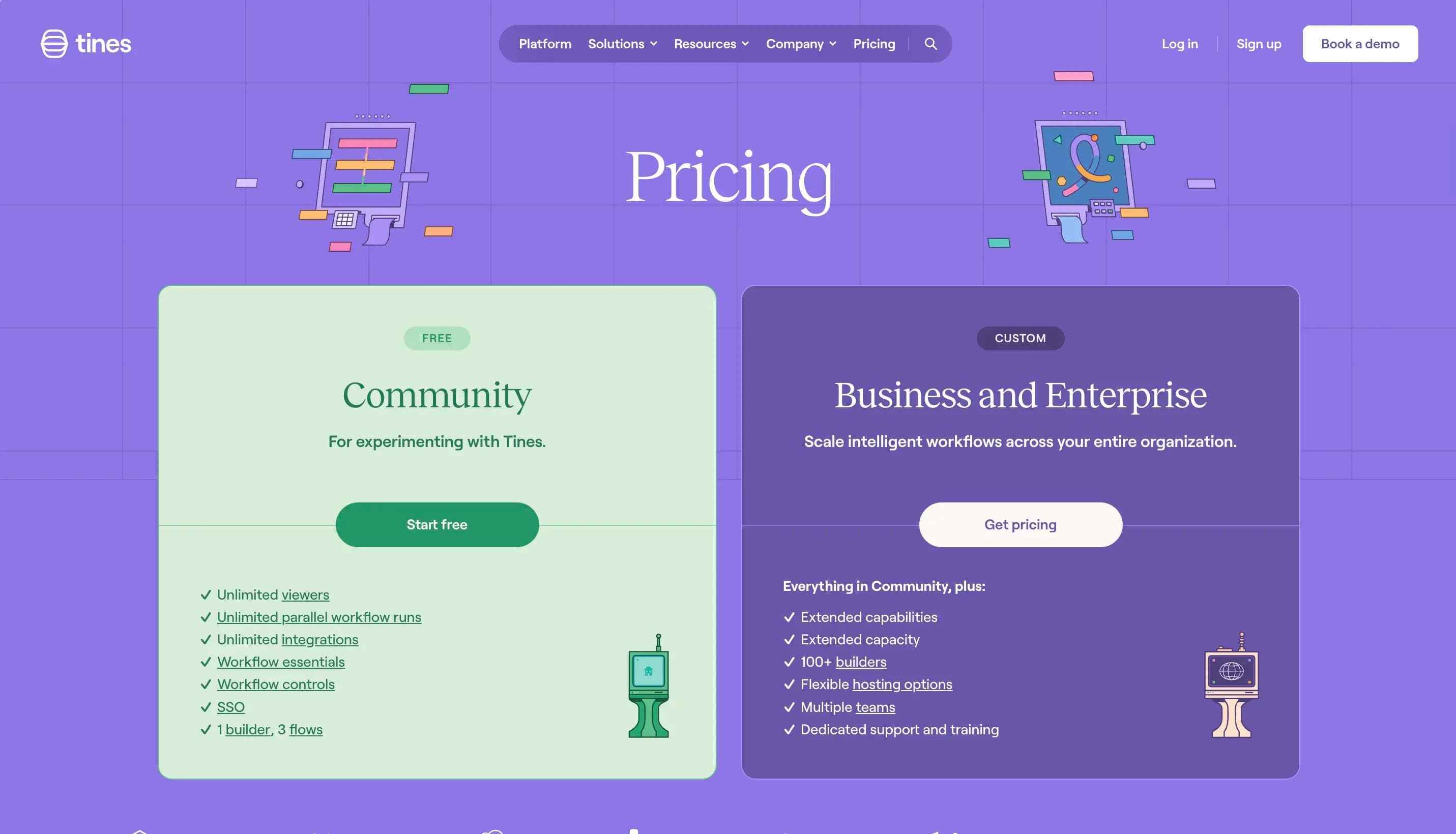
Tines uses a non-traditional pricing page worth understanding on its own terms.
Tines shows exactly two options: a free Community tier with explicit limits (one builder, three flows, unlimited viewers and integrations) and a single "Business and Enterprise" tier with no published price at all, gated entirely behind a demo request. This is a freemium-to-sales-led model: a buyer can fully evaluate the product on the free tier, but any paid commitment requires a sales conversation with no visible pricing logic to anchor expectations beforehand.
This is worth reading as a deliberately opaque enterprise pricing page that still manages to feel approachable through its visual design and tone, rather than as an example of transparent usage-based pricing.
SaaS Pricing Page Design Choices We Love From Tines:
- Brand-forward, illustrated design that keeps a sales-gated page from feeling cold
- Clear, specific limits on the free tier (1 builder, 3 flows) rather than a vague "limited" label
- Logo wall of recognizable enterprise customers placed directly beneath the two-tier comparison
- Specialized edition callouts (federal, SLED, MSSP) that route different buyer types to the right conversation without cluttering the main page
11. Brex
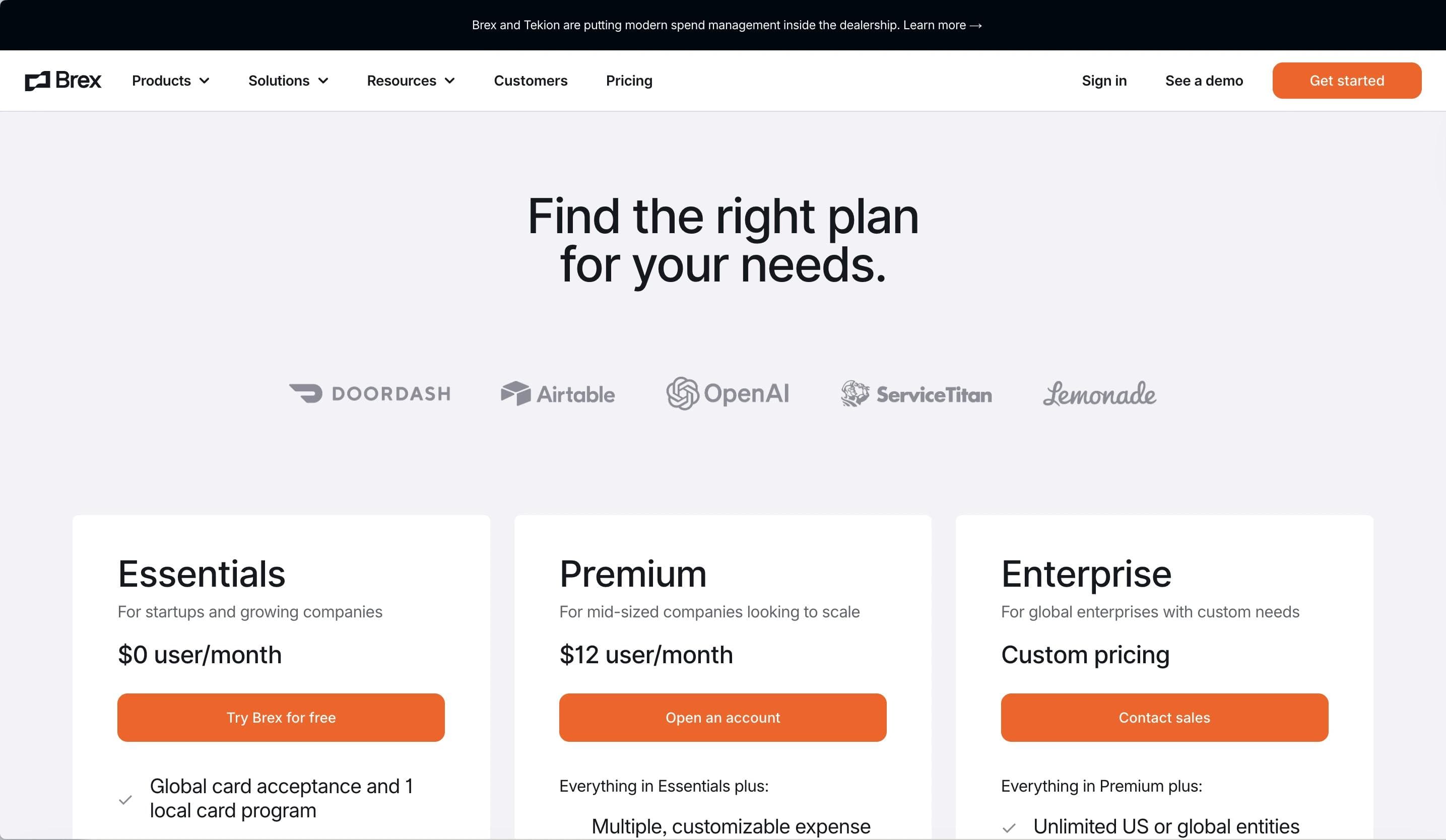
Brex publishes specific self-serve pricing: Essentials is free, Premium is $12 per user per month (with a 20% discount for annual billing), and Enterprise remains custom.
AI-powered compliance audit detection appears as a named Premium feature alongside dynamic expense review chains and advanced approval workflows. Credit limits are described in relative terms (5 to 20% of linked bank balance) rather than fixed numbers, which keeps the underlying banking mechanics opaque even where the subscription pricing is clear.
SaaS Pricing Page Design Choices We Love From Brex:
- Published self-serve pricing on Premium, a meaningful transparency upgrade from custom-quote-only
- AI-powered compliance audit detection named explicitly as a Premium-tier differentiator
- Clear annual billing discount (20%) shown directly against the monthly price
- Tier-by-tier feature inheritance ("Everything in Essentials, plus...") that keeps the comparison easy to follow despite a long feature list
12. Netlify
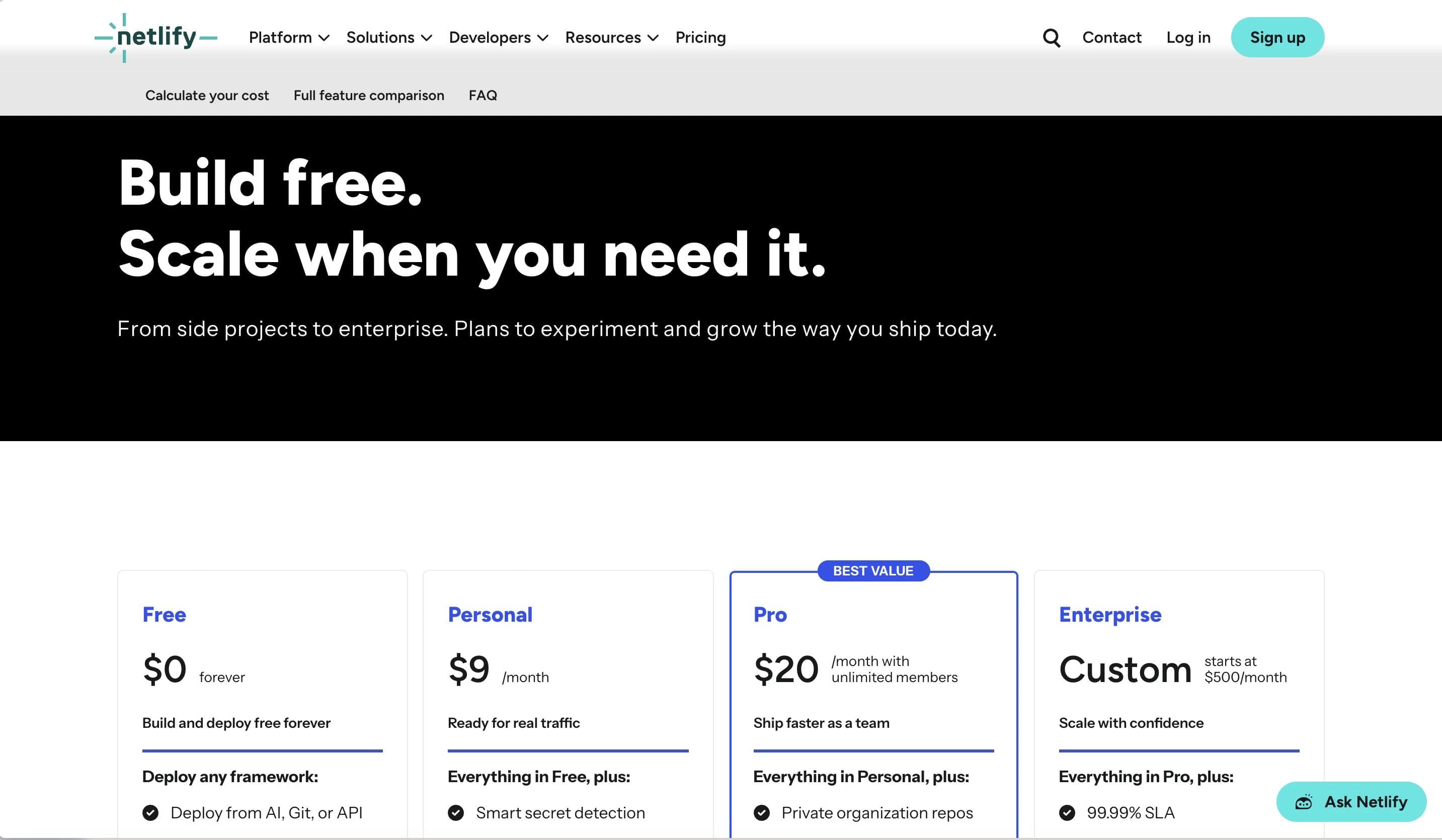
Netlify's pricing page runs on a fully credit-based model across four tiers: Free, Personal, Pro, and Enterprise. Every metered feature, including production deploys, compute, bandwidth, and web requests, draws from the same monthly credit pool, and the page includes a dedicated breakdown of exactly how many credits each action costs.
AI inference is its own metered line item, priced according to which AI model a project uses, alongside an "Agent Runners" feature that lets AI agents fix and ship code directly from the dashboard. The page also includes an FAQ section for existing customers on legacy pricing, a thoughtful detail for any company managing a pricing model migration without disrupting current accounts.
SaaS Pricing Page Design Choices We Love From Netlify:
- Transparent, per-action credit costs published directly on the pricing page, not buried in docs
- AI inference metered and explained as its own category rather than folded into generic compute
- Dedicated FAQ for customers on legacy plans, reducing support load during a pricing migration
- Full feature comparison table addressing build/deploy, collaboration, members, security, and support by tier
13. Privy
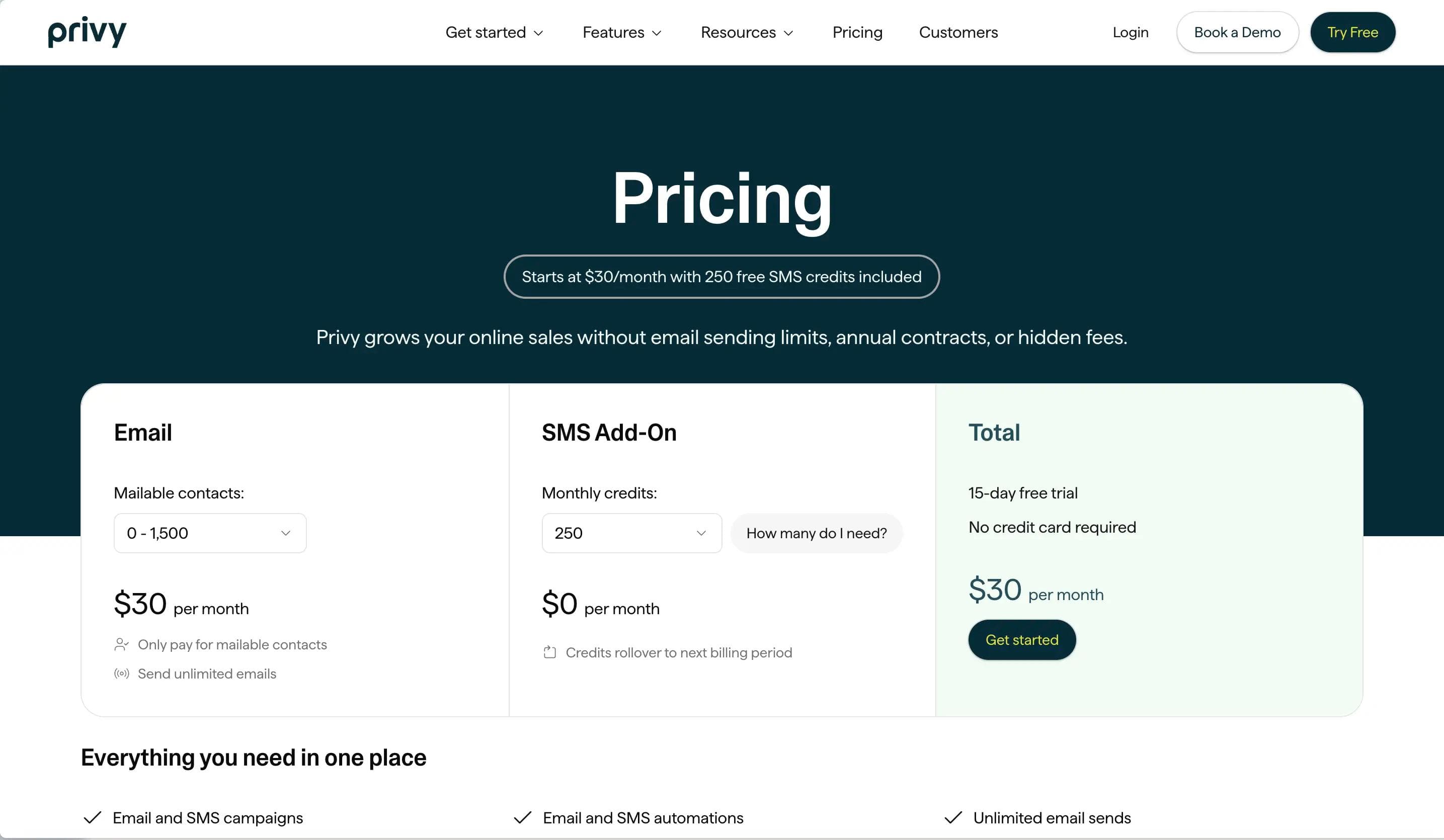
Privy is built around two separate paths: an Email-plus-SMS-Add-on calculator, where buyers pick a contact volume and optionally add SMS credits, and a separate "Pop-ups & Displays only" track priced by monthly page views for merchants who only want the on-site conversion tools.
An interactive calculator is the centerpiece of the page, recalculating cost based on mailable contacts and SMS credits rather than a fixed tier. The 15-day free trial and "no credit card required" framing round out the offer.
SaaS Pricing Page Design Choices We Love From Privy:
- Interactive calculator that recalculates total cost live as inputs change
- Clear separation between the full platform and a standalone Pop-ups & Displays option for merchants who don't need email or SMS
- Unlimited email sends positioned as a baseline, not an upsell
- Straightforward FAQ addressing exactly what counts as a "mailable contact" and what happens at the contact limit
If your final price requires a sales conversation: the live calculator pattern is worth borrowing regardless. Showing a buyer roughly where their usage lands, even with a "request a custom quote" button at the end instead of a checkout button, gives them something concrete to bring into an internal budget conversation instead of an open-ended unknown.
14. Jasper

Jasper's pricing page runs two plans: Pro at a published per-seat price and Business at custom pricing, in a restrained, enterprise-oriented layout built around a long feature comparison table.
Jasper's "IQ" layer (Brand Voice, Knowledge, Audiences, Style Guide) and a credits system power usage-based features like the GEO Hub and Agents, sitting alongside the flat per-seat pricing for standard content creation. This mirrors a pattern seen elsewhere in this list: a flat subscription price for core use, plus a metered layer for AI-specific capability.
SaaS Pricing Page Design Choices We Love From Jasper:
- Clear two-tier structure (Pro/Business) that avoids decision fatigue on a feature-dense product
- IQ customization limits (Brand Voices, Knowledge assets, Audiences) shown as concrete numbers per tier, not vague "limited/unlimited" labels
- Credits explained separately from seat pricing, with a dedicated FAQ distinguishing what does and doesn't consume credits
- Extensive trust and security section (SOC 2, GDPR, SSO, audit logs) placed directly on the pricing page rather than linked elsewhere
15. Loom
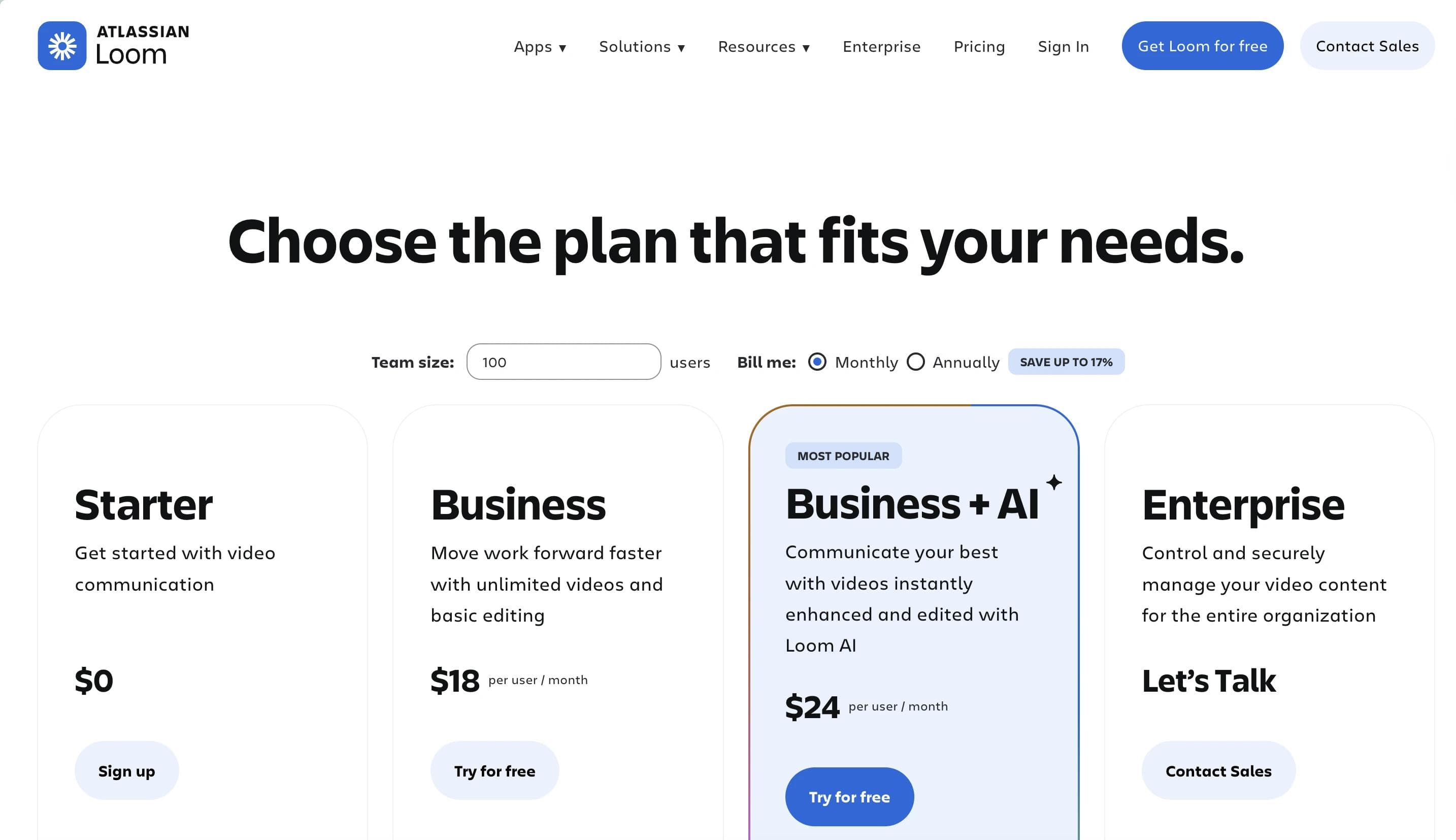
Loom's pricing page runs a clear tier structure: Starter, Business, Business + AI, and Enterprise, with Business + AI carrying the "Most Popular" label, a useful signal that Loom's own AI tier, not just its highest tier, is what most buyers choose.
Loom AI is a fully named pricing tier rather than an add-on, bundling auto-titles, auto-summaries, auto-chapters, filler word removal, auto-meeting notes, and recap features. The page also discloses, in its FAQ, exactly what data is sent to OpenAI for AI processing (transcript text only, not video or audio), a level of specificity that builds trust on a feature buyers are often wary of.
SaaS Pricing Page Design Choices We Love From Loom:
- "Business + AI" as a named, most-popular tier rather than an AI add-on bolted onto an existing plan
- Specific, quantified AI value props in the FAQ (67% of users don't edit auto-generated titles, 18% more viewer engagement)
- Transparent disclosure of exactly what data reaches third-party AI providers
- Clean tier-to-tier feature inheritance that keeps a long feature list scannable
16. Ahrefs
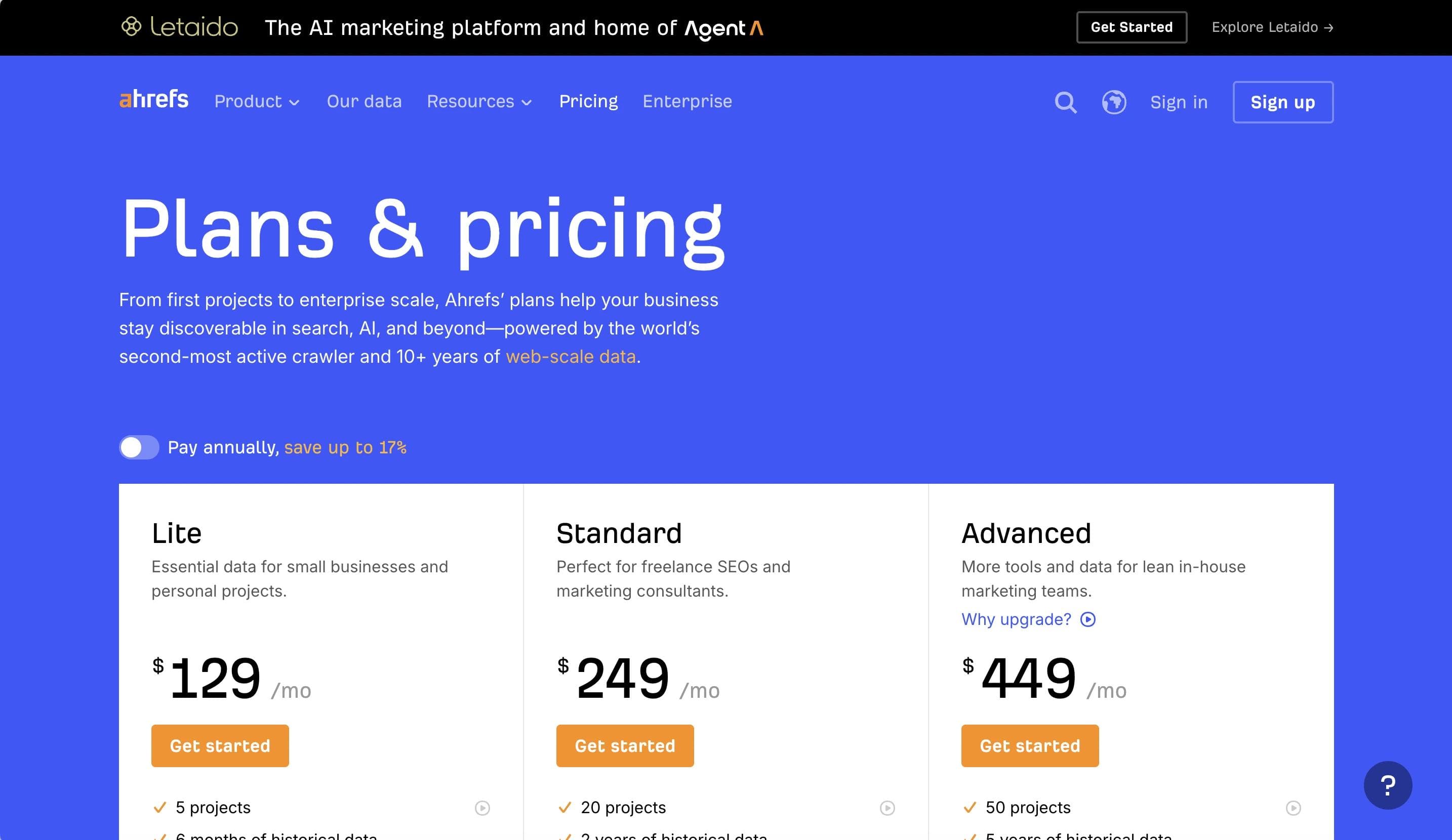
Ahrefs keeps its familiar Lite, Standard, and Advanced tier names alongside an annual-billing discount toggle, and adds AI visibility tracking as a core pricing dimension. Each tier includes a number of tracked AI prompts and Brand Radar checks, reflecting Ahrefs' expansion from traditional SEO into AI search visibility.
A substantial add-on marketplace sits beneath the core tiers (Content Kit, Report Builder, Project Boost Pro and Max), each with its own monthly price, plus a separate standalone Brand Radar AI product and custom prompt packages priced by check volume. The core tier comparison table breaks out credits, historical data windows, and crawl limits by tier in detail.
SaaS Pricing Page Design Choices We Love From Ahrefs:
- AI prompt tracking and Brand Radar checks built into every tier, not sold as a separate product only
- Granular add-on marketplace with clear monthly pricing for each (Content Kit, Report Builder, Project Boosts)
- Anchored pricing plan bar with a clean monthly/annual toggle
- Detailed compare-plans table broken into clear sections (users, projects, historical data, Brand Radar, API)
17. Semgrep
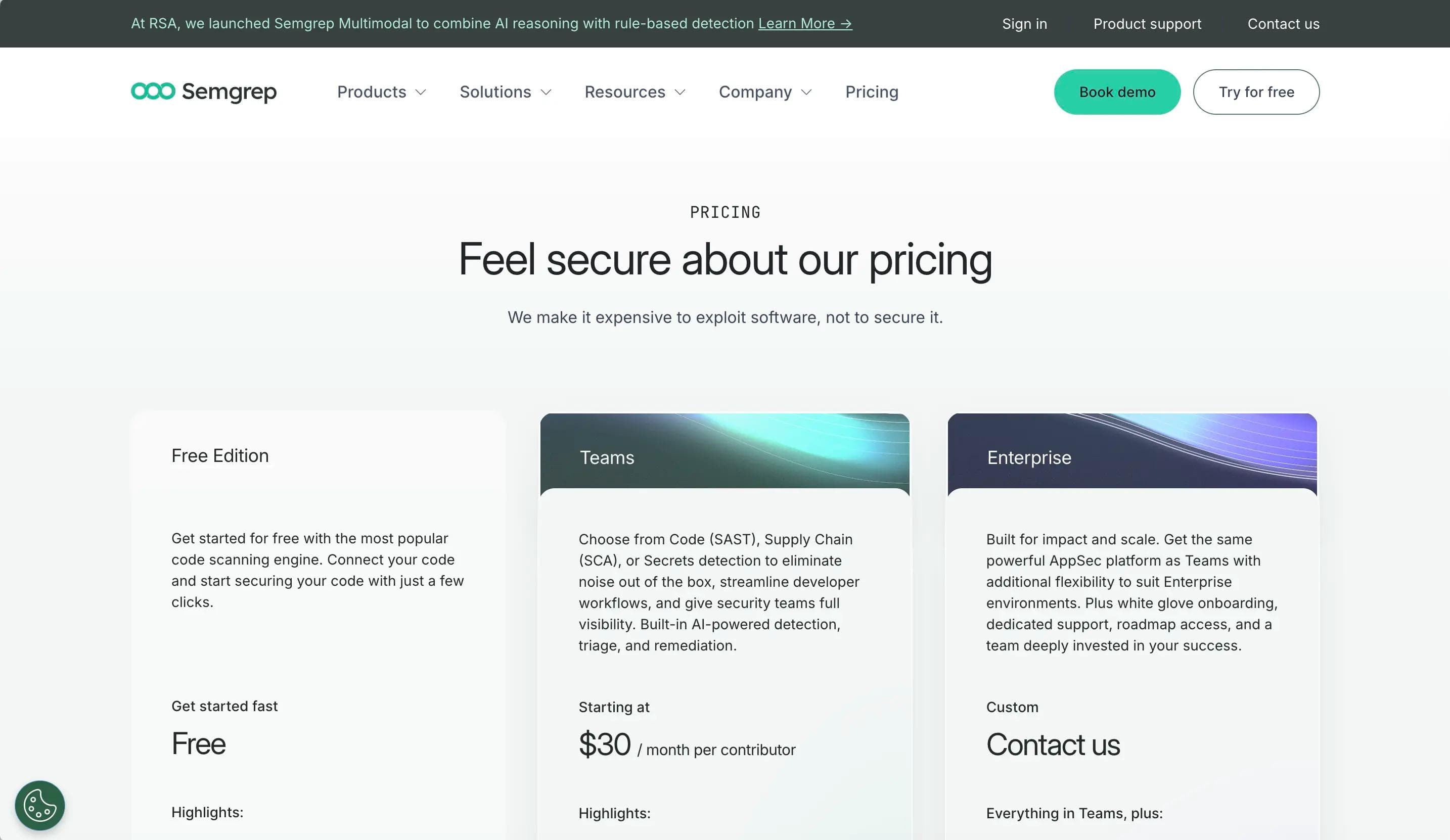
Semgrep sells a three-tier structure: Free Edition, Teams, and Enterprise, where buyers choose which products (Code, Supply Chain, Secrets) to add rather than picking a tier that already bundles them. AI credits are a stated quantity per tier (60 free, 20 per developer per month on Teams, 50 per developer per month on Enterprise), tied directly to Semgrep's Multimodal AI detection and remediation features.
The detailed feature comparison table is a strength of this page, organized by capability area (Code, Supply Chain, Secrets, Multimodal AI, source code management, integrations, security, support) with clear check marks and specific limits at every row.
SaaS Pricing Page Design Choices We Love From Semgrep:
- Product-choice pricing model (pick Code, Supply Chain, or Secrets individually) instead of forcing a bundle
- AI credits quantified per developer per month, directly tied to the Multimodal AI feature set
- Detailed FAQ addressing data privacy specifically for AI-powered features, separate from general security FAQs
- Customer logo wall (Dropbox, GitLab, Shopify, Slack, Snowflake, Figma) placed for credibility without overwhelming the pricing table
Semgrep's Enterprise row for "self-managed / on-prem repositories" and "custom CI/CD integrations" is a direct answer to the kind of infrastructure constraint that kills security tooling deals at larger accounts when it isn't addressed up front. Naming on-prem support explicitly, rather than leaving it for a sales conversation, pre-qualifies the buyers who actually need it.
18. HubSpot
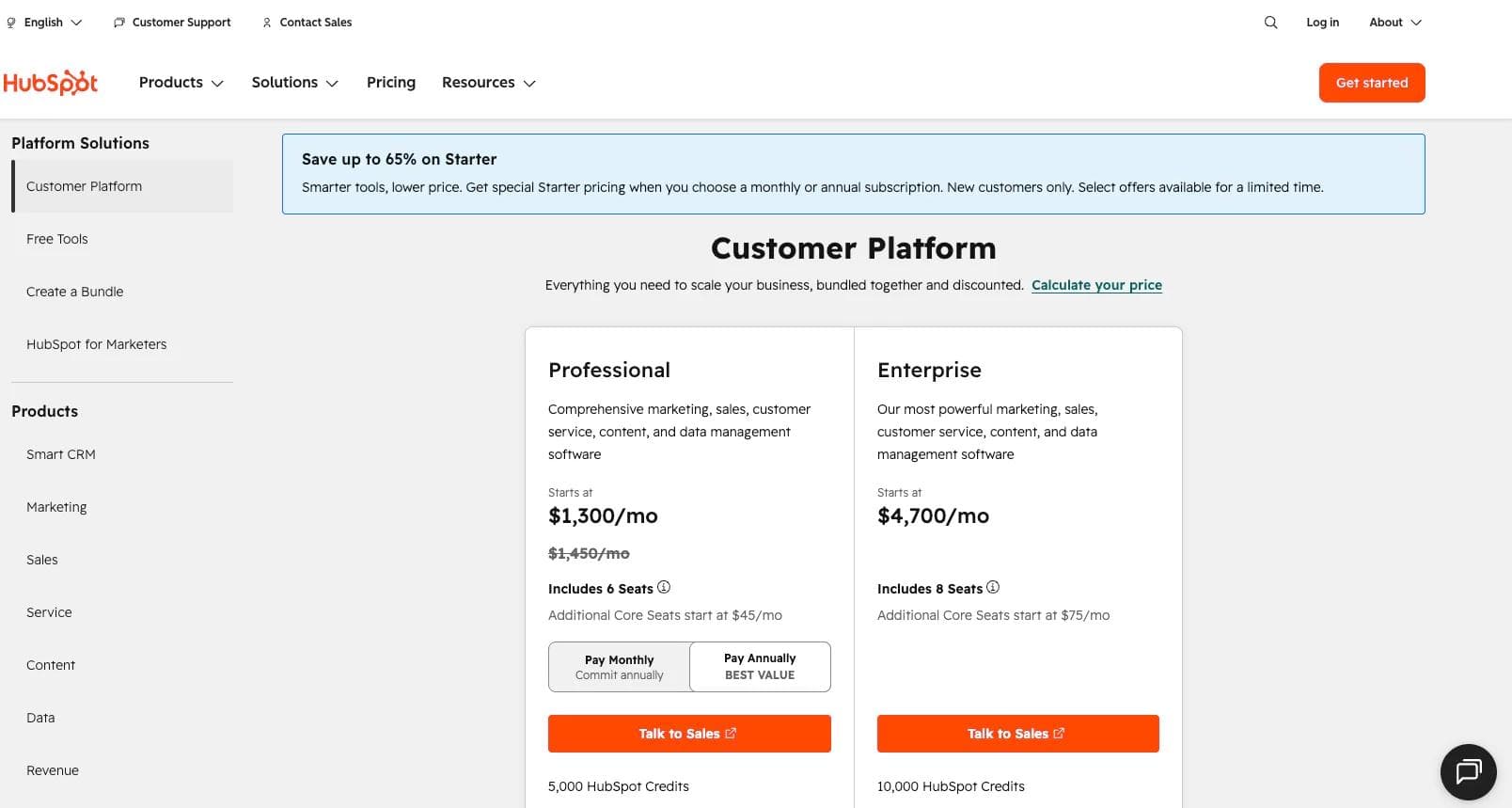
HubSpot's Customer Platform pricing bundles Marketing, Sales, Service, Content, and Operations Hubs into a single subscription at a discounted rate versus buying each hub separately, with the Enterprise tier landing around $4,300 per month for five to seven seats. This bundled framing is the right entry point for a buyer evaluating HubSpot as a full go-to-market stack rather than a single department's tool, since the per-hub pages each tell only part of the cost story.
HubSpot Credits are the explicit currency for AI features across the bundle, and Enterprise opens up the deepest tier of AI capability: the Customer Agent and Data Agent are metered by credit rather than capped by seat, and Enterprise also adds custom objects, hierarchical teams, partitioning, advanced permissions, and sandboxes, the governance layer a buyer running marketing, sales, and service through one platform will need. HubSpot AI agents are positioned with specific, quantified outcomes (70%+ of conversations resolved automatically, 39% faster ticket resolution, 78% improvement in data-driven decisions) directly in the pricing flow, which gives a buyer something concrete to bring into their own internal evaluation before a deal review.
SaaS Pricing Page Design Choices We Love From HubSpot:
- A bundled platform view that prices the full stack together instead of forcing a buyer to add up five separate hub quotes
- HubSpot Credits as a single, explained currency that powers every AI feature across every hub, including at the Enterprise tier
- Quantified AI outcome stats (resolution rate, ticket speed, data-driven decision improvement) shown directly next to the agents they describe
- Enterprise-specific governance features (custom objects, hierarchical teams, partitioning, sandboxes) named explicitly rather than left for a sales conversation to surface
19. Customer.io
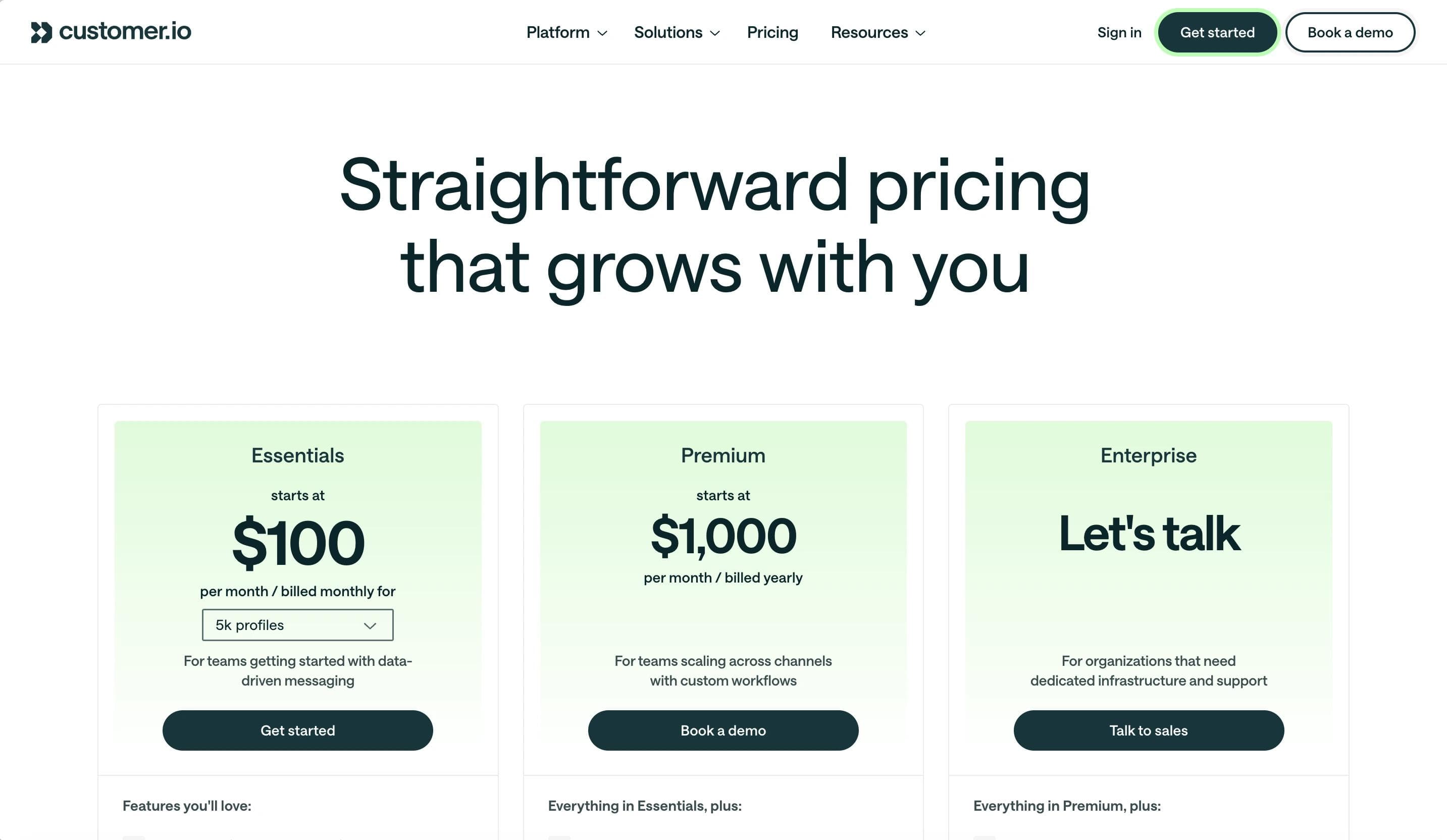
Customer.io uses Essentials, Premium, and Enterprise tier names with a "Let's talk" Enterprise CTA. Premium starts at $1,000 per month on an annual term, while Essentials is the accessible entry tier at $100 per month for 5,000 profiles.
An AI Agent (beta) section runs across the entire comparison table, covering session limits, persistent memory, custom execution skills, and scheduled "Routines" that scale from weekly on Essentials to daily on Premium. This is one of the more AI-forward comparison tables in this list, with a dedicated row for nearly every AI capability rather than a single catch-all mention.
SaaS Pricing Page Design Choices We Love From Customer.io:
- AI Agent capabilities broken into specific, comparable rows (session limits, memory, custom skills, routine frequency) rather than a single feature bullet
- Clear "starts at" framing on Premium that signals custom scaling without hiding the entry price entirely
- Startup program callout offering 12 months free, placed prominently between the pricing cards and the full comparison table
- Comprehensive comparison table spanning channels, journeys, audiences, design studio, data, reporting, security, and support
How AI is reshaping pricing pages
AI credits, agent hours, and usage-based AI line items have become close to universal across SaaS pricing pages. Of the nineteen examples in this article, at least eight carry a dedicated AI pricing dimension, and several others build AI directly into their pricing structure as a core feature rather than an add-on:
- AI as a metered add-on: Aircall, Retool, Netlify, Slack, Ahrefs, Semgrep, Brex, Customer.io
- AI built into the core pricing structure: Chili Piper, Jasper, Loom, HubSpot, PostHog
Pattern 1: credits layered on top, not replacing the model
The pattern that shows up most often is a credit or token allotment layered on top of an existing seat-based or usage-based price, rather than AI replacing the underlying pricing model.
- Quantified credits or checks per tier: Retool, Netlify, Ahrefs, and Semgrep all state exactly how many AI credits or checks come with each tier.
- AI as its own row in the comparison table: Slack, Customer.io, and HubSpot go further and break AI capability into its own row or section, treating it as a primary axis for differentiation rather than a footnote.
Pattern 2: visibility splits by motion, not by size
A second pattern worth watching is that pricing visibility tracks how a product sells, not how large its customers are.
- Less visible pricing as AI capability grows: Chili Piper and Tines, both selling into larger accounts, have moved toward gated or custom pricing even as their AI capability has expanded.
- Transparent pricing with AI added as a line item: Netlify, Retool, and Customer.io have kept their pricing visible and simply added AI as a new metered line.
Opacity at the high end isn't necessarily a problem. Custom AI pricing at scale is often genuinely variable, and a buyer expecting a negotiated relationship usually isn't put off by a "contact us" link. But it does shift the burden to sales to explain the AI cost model clearly and quickly once a prospect engages, since there's nothing on the page to anchor expectations beforehand.
What the best examples have in common
The vendors in this list that handled AI pricing best, at any tier, did three things:
- Named the AI capability specifically instead of folding it into a vague "AI-powered" claim.
- Attached a concrete number to it (credits, checks, session limits, included AI minutes).
- Kept that number visible alongside the rest of the pricing table rather than hiding it behind a single "Contact us for AI pricing" link.
Building a pricing page that holds up as your product changes
These examples show how much clear structure and trust signals matter on a pricing page, and how much that structure shifts as products grow more complex or sell into different segments. Whatever your buyer base looks like, that's a governance problem as much as a design one: your pricing page is one of the few places where product, security, and revenue teams all need to sign off on the same content, and it needs a refresh cadence that matches how fast your AI roadmap is moving.
From our experience with SaaS websites, we believe every company must treat their pricing page like they would any other core website page: not a static asset, but a living one that needs the same governance and update cadence as the rest of the site. If executed correctly, your pricing page can become your advantage in a heavily competitive SaaS market.
Keep these points in mind when redesigning your own pricing page:
- Having a sound pricing strategy and model will greatly aid the design process.
- Do not overlook the mobile design of your pricing page, even for a primarily sales-led product. Buyers further up the org chart still pull pages up on their phones.
- Ensure your pricing table and copy are easily digestible for whoever is actually reading it, whether that's a single self-serve signup or a buying committee with mixed technical depth.
- Less information can make a page clearer. Avoid clutter, but don't hide the detail a more complex buyer will need to make their case internally.
- Establish trustworthiness throughout the page, and match the proof to the audience: review counts and ratings for a self-serve buyer, named certifications and specific limits for a buyer further up the stack.
- Strategically place CTAs to move leads down the funnel, with a clear self-serve path and a clear "talk to sales" path on the tiers that need one.
- Build a review cadence into your pricing page governance. If your product is shipping AI features at the pace most of the SaaS market is right now, your pricing page needs a refresh schedule that keeps pace with it.
The pricing page is a conversion endpoint and a qualification tool. With buyers cutting vendors and preferring self-directed research, it's increasingly the tool prospects use to qualify or eliminate you, often well before a formal evaluation process starts. Get the layout right with transparent pricing and clear trust signals, and you turn a passive page into your strongest sales asset. Talk with Webstacks to build a pricing page that converts and stays current, whoever it needs to convert.

Your website is your biggest growth lever—are you getting the most out of it? Schedule a strategy call with Webstacks to uncover conversion roadblocks, explore high-impact improvements, and see how our team can help you accelerate growth.