How to Increase Website Conversions for SaaS Businesses (2026 Guide)


Conversions are the lifeblood of SaaS growth. If you’re not converting, you’re not growing.
The average conversion rate for SaaS free trials ranges between 2% and 5%. To maintain positive ROI, most SaaS companies need to perform within or above this range, like Slack, whose conversions reach up to 30%.
Let’s break down what you need to know about SaaS website conversions.
In brief:
- SaaS website conversions heavily depend on delivering seamless, engaging user experiences that instill trust and credibility.
- Clear messaging and intuitive navigation ensure potential customers understand the product's value proposition quickly.
- Offering trials helps users evaluate the product risk-free, driving conversion rates for hesitant customers.
- Regularly analyzing performance metrics helps refine website elements, ensuring continuous improvement in user engagement and conversions.
Before diving into optimization tactics, it's worth establishing what we mean by conversions and why they matter to SaaS business models specifically.
What's a SaaS Website Conversion?
SaaS website conversions refer to the actions visitors take that move them closer to becoming paying customers. This can include signing up for a free trial, subscribing to a newsletter, or completing a purchase.
Conversions drive revenue and user acquisition. Without them, your SaaS business stagnates. Every conversion represents a step toward scaling your operations and increasing market share.
Track metrics like conversion rate, customer acquisition cost (CAC), and lifetime value (LTV). These are the key metrics for SaaS websites, and provide insights into how well your website converts visitors and the overall health of your SaaS business.
We partner with high-growth tech brands to design, build, and scale websites that marketers and end-users love.

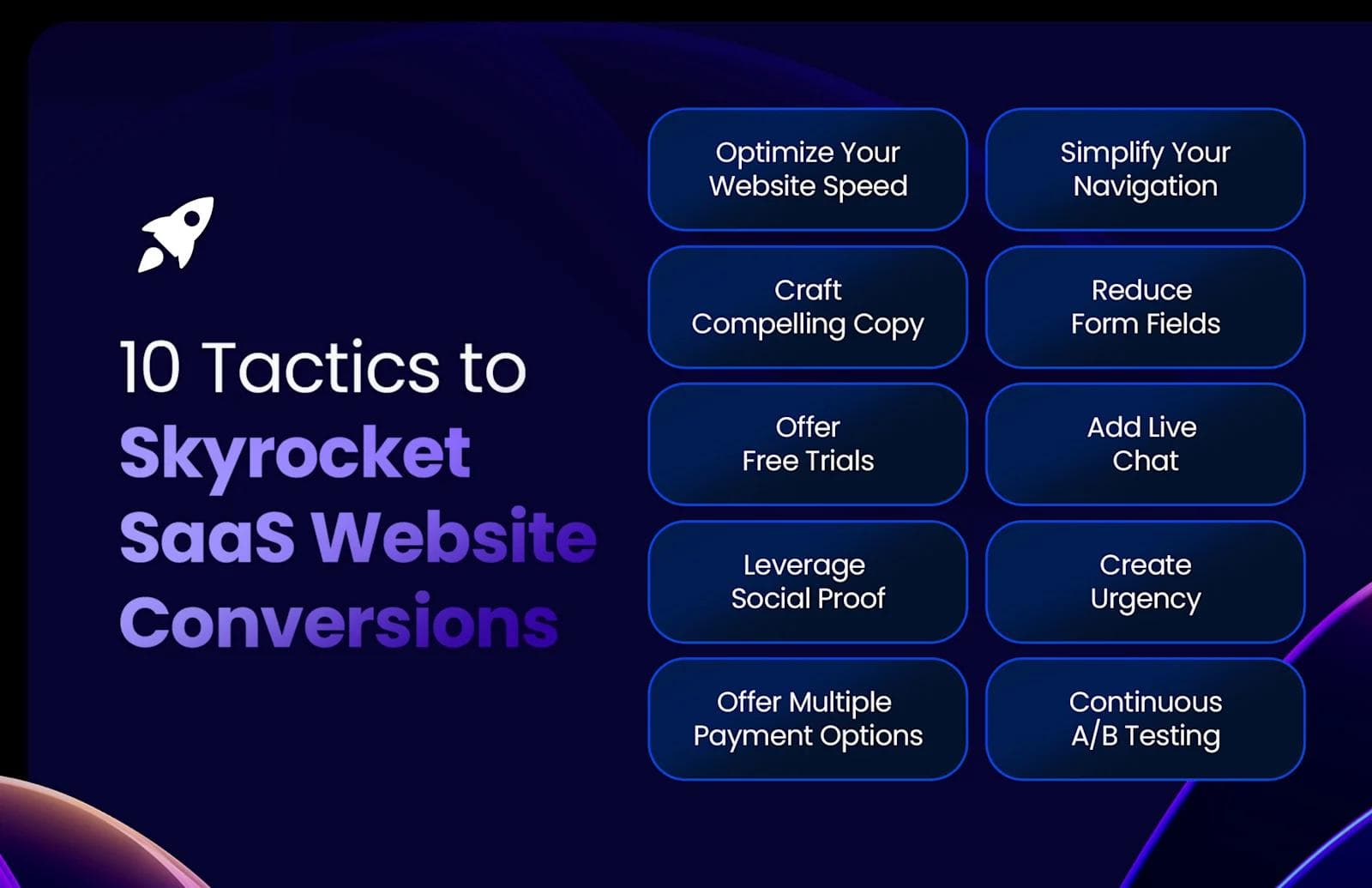
10 Proven Tactics to Skyrocket Your SaaS Website Conversions
Conversion optimization works best when you address systemic issues before surface-level tweaks. These ten tactics are organized roughly by implementation priority, though your specific bottlenecks should guide where you start. Foundation elements like speed and navigation enable everything else.
1. Optimize Your Website Speed
Website speed directly impacts user experience and conversions. Speed matters differently across the funnel. Homepage speed affects bounce rates and brand perception. Pricing page speed impacts purchase decisions. Trial signup flow speed directly determines conversion completion rates. Prioritize optimization based on where users drop off most frequently.
Slow-loading pages frustrate visitors and increase bounce rates. Improving CRO with UX design on your website keeps users engaged and improves conversion rates.
Thus, aim for a load time of under three seconds. Use tools like Google PageSpeed Insights to identify and fix issues. Compress images, leverage browser caching, and minimize JavaScript and CSS files.
2. Simplify Your Navigation
Clear, intuitive navigation helps users find what they need quickly. Use a clean layout with straightforward menu items. Avoid clutter and keep the number of menu options limited. Ensure that important pages like pricing, product features, and contact information are easily accessible. Simplified navigation reduces friction and guides users toward conversion actions.
3. Craft Compelling Copy
Your website copy should resonate with your target audience. Focus on benefits rather than features. Use clear, concise language that speaks directly to the user's needs and pain points.
Headlines should grab attention, and subheadings should guide the reader through the content. Include strong calls-to-action (CTAs) that tell users exactly what to do next. Compelling copy can persuade visitors to take the desired actions.
4. Offer Free Trials
Free trials allow users to experience your product without commitment. Clearly advertise the trial on your homepage and product pages. Make the sign-up process simple and quick. Provide guidance during the trial to help users understand and utilize key features.
A well-executed free trial can convert trial users into paying customers by demonstrating the value of your product. Trial effectiveness depends on product complexity and sales model. Simple tools benefit from self-serve trials with minimal friction. Complex enterprise software often requires guided trials with sales touchpoints at key activation milestones. Match your trial structure to how customers actually evaluate and adopt your product.
5. Reduce Form Fields
Lengthy forms deter users from completing them. Only ask for essential information. Use single-column layouts and clear labels. If possible, use autofill options to make the process faster. Reducing the number of form fields minimizes friction and increases the likelihood of form submissions, leading to higher conversions.
6. Add Live Chat
Live chat provides immediate assistance to visitors. Implement a live chat feature on key pages like the homepage, product pages, and checkout. Ensure that chat agents are knowledgeable and responsive. Use automated chatbots to handle common queries and direct users to the right resources.
Live chat can address user concerns in real time, helping to convert hesitant visitors into customers.
7. Leverage Social Proof
Social proof builds trust and credibility. Display customer testimonials, reviews, and case studies prominently on your site. Include logos of well-known clients or partners. Highlight user-generated content, such as social media mentions or customer photos.
Social proof works differently at each funnel stage. Early-stage visitors need category validation: showing you're an established player. Mid-funnel visitors want proof of outcomes through case studies showing measurable results. Late-stage visitors seek peer validation from testimonials by companies similar to theirs.
8. Create Urgency
Urgency encourages users to act quickly. Use limited-time offers, countdown timers, and low-stock alerts to create a sense of urgency. Highlight the benefits of acting now, such as discounts or bonuses. Urgency can push users who are on the fence to make a decision and complete the conversion.
9. Offer Multiple Payment Options
Offering various payment options caters to different user preferences. Include popular methods like credit cards, PayPal, and digital wallets. Ensure that the payment process is secure and straightforward. Multiple payment options reduce barriers to purchase and accommodate a wider range of customers, boosting conversions.
10. Continuous A/B Testing
A/B testing helps identify what works best for your audience. Test different headlines, images, CTAs, and page layouts. Use tools like Google Optimize or Optimizely to run experiments. Analyze the results and implement changes based on data. Continuous A/B testing allows you to refine your website and improve conversion rates over time.
Effective testing requires discipline. Test one variable at a time on high-traffic pages first. Low-traffic pages take weeks or months to reach meaningful results, making them poor testing candidates. Focus testing resources where they'll generate learnings fastest—typically homepage, pricing page, and primary conversion flows.
These tactics provide the implementation layer. To understand whether they're working, you need benchmark context for what constitutes good performance in SaaS.
3 Essential SaaS Conversion Rate Benchmarks
Benchmarks help you assess whether your conversion rates signal a problem or simply reflect your market and business model. These three benchmark types provide different lenses for evaluating performance. Understanding where you stand compared to industry standards can be eye-opening and help you set realistic goals.
1. Average Conversion Rate By Industry
Conversion rates can vary significantly across different industries.
For SaaS businesses, the average conversion rate typically ranges from 2% to 5%. However, some sectors like financial services and healthcare may see higher rates due to the specialized nature of their offerings.
On the other hand, industries with more competitive markets, such as e-commerce or marketing tools, might experience lower average conversion rates.
These ranges reflect different buyer behaviors and evaluation processes. Products with shorter time-to-value typically convert faster. Enterprise solutions with multiple stakeholders and lengthy procurement processes convert more slowly but often deliver higher lifetime value. Your conversion rate matters less than your efficiency at moving qualified buyers through their natural evaluation timeline.
2. Factors Impacting Conversion Rates
Several factors can influence your SaaS website conversions. Different CRO strategies for SaaS websites are available for you to enhance your conversion rates. Conversion rates don't exist in isolation—they interact with other metrics in your growth model.
A higher conversion rate from poor-quality traffic yields worse outcomes than a lower conversion rate from well-qualified visitors. The goal isn't maximizing conversion rate but optimizing the relationship between traffic quality, conversion rate, and customer value.
- User experience plays a significant role; a well-designed, intuitive interface can lead to higher conversions.
- The quality of your traffic also matters—targeted, high-intent visitors are more likely to convert.
- Additionally, pricing models, the clarity of your value proposition, and the effectiveness of your call-to-action (CTA) buttons can all impact conversion rates.
- External factors like market trends and economic conditions may also affect user behavior and conversion rates.
Understanding these interacting factors helps you diagnose performance issues and set realistic improvement targets based on your specific business context.
3. Realistic Conversion Goals
Goal-setting requires understanding your specific context. A freemium product converting anonymous visitors to free users operates differently than an enterprise platform converting demo requests to opportunities. Rather than targeting arbitrary percentages, establish your baseline, identify your primary bottleneck, and set improvement goals based on fixing specific friction points. A 0.5 percentage point improvement in trial conversion often delivers more revenue impact than doubling traffic.
Remember, continuous testing and optimization are key to achieving and surpassing these goals. Consider building a B2B marketing tech stack to support your conversion goals effectively.
We partner with high-growth tech brands to design, build, and scale websites that marketers and end-users love.
How to Analyze Your SaaS Website's Conversion Performance?
Effective analysis goes beyond checking dashboards. It requires structured methodology: define what success means, measure it accurately, interpret the data correctly, and identify specific opportunities. This four-step process provides that structure.
Identify Conversion Goals
Effective goals align with your growth model. Product-led growth companies prioritize self-serve activation milestones. Sales-led companies focus on qualified lead generation and sales opportunity creation. Hybrid models need clear handoff points between product-driven and sales-driven motions.
Start by defining what you want visitors to achieve on your website. These goals could include signing up for a free trial, subscribing to a newsletter, or completing a purchase.
Clear goals help you focus on the actions that drive growth. For instance, if increasing free trial sign-ups is a priority, tailor your website to guide users toward that action.
Set Up Conversion Tracking
Once you have your goals, set up tracking to measure your website’s ROI. You can use tools like Google Analytics, Mixpanel, or other analytics platforms to monitor user actions. Implement tracking codes on key pages to capture data on user behavior.
Ensure you track events like button clicks, form submissions, and page views. Accurate tracking provides the data needed to evaluate performance. Once tracking captures accurate data, regular analysis reveals patterns that indicate what's working and what needs attention.
Analyze Conversion Data
With tracking in place, regularly review your data to understand how users interact with your site. Look beyond surface metrics. High bounce rates might indicate targeting problems, not design issues. Low form completion might reflect qualification working correctly—filtering out poor-fit prospects. Context determines whether a metric signals a problem or confirms your strategy is working as intended.
For example, efficient content workflows can also significantly impact conversions, or if a high percentage of users drop off at a specific step in the sign-up process, investigate why. Use heatmaps and session recordings to see where users click and how they navigate your site. General analysis reveals trends. Pinpointing specific bottlenecks tells you exactly where to focus improvement efforts.
Pinpoint Conversion Bottlenecks
Not all bottlenecks merit fixing. Some friction serves a purpose—qualifying leads, setting expectations, filtering poor-fit customers. Prioritize bottlenecks where qualified prospects encounter unnecessary obstacles. The goal is removing friction from the right actions, not eliminating all friction entirely.
Identify where users encounter obstacles. Bottlenecks can occur at various stages, such as slow-loading pages, confusing navigation, or lengthy forms. Use your data to pinpoint these issues.
For example, if users abandon the sign-up form, check if it's too long or ask for unnecessary information. Addressing these bottlenecks can significantly improve your conversion rates.
If your current website infrastructure or hosting plan (or both) prevent you from growing, you may consider migrating your SaaS website to a new infrastructure.
How to Create High-Converting SaaS Landing Pages
Landing pages serve as focused conversion instruments. Unlike general website pages that support multiple objectives, landing pages exist for one purpose: moving visitors toward a specific action. That singular focus makes them both easier to optimize and more impactful when done well.
Essential Elements Of Saas Landing Pages
Landing pages exist within a larger conversion ecosystem. They receive traffic from specific sources with specific intent. High-performing landing pages maintain message consistency with the source—ad copy, email message, or referring content—while moving visitors toward the next logical step. Disconnected landing pages, regardless of design quality, underperform because they break the visitor's mental model of their journey. Your SaaS landing page needs to grab attention and drive action.
- Start with a clear, compelling headline that addresses a pain point or offers a solution and consists of keywords you have uncovered. Follow this with a subheadline that provides more detail and reinforces the main message.
- Next, include a strong call-to-action (CTA). This should stand out and tell visitors exactly what to do next, whether it's signing up for a free trial, downloading a resource, or scheduling a demo.
- Visuals are also key. Use high-quality images or videos that showcase your product in action. These visuals should support your message and help visitors understand the benefits of your product.
- Customer testimonials and logos of well-known clients add credibility. Social proof reassures potential customers that others have had positive experiences with your product.
- Lastly, fine-tune the user experience by ensuring your landing page is mobile-friendly. Many users will access your site from their phones, and a responsive design ensures a smooth experience across all devices.
Understanding what elements matter provides the foundation. How you implement and refine those elements determines actual performance.
Landing Page Best Practices
Understanding what elements matter provides the foundation. How you implement and refine those elements determines actual performance.
- Keep your landing page simple and focused. Avoid clutter and distractions that can divert attention from your main message. Use white space to make the content easy to read and navigate.
- A/B testing is vital. Test different headlines, images, CTAs, and layouts to see what resonates best with your audience. Use the data to make informed decisions and continuously optimize your page.
- Load speed matters. A slow-loading page can frustrate visitors and increase bounce rates. Optimize images, leverage browser caching, and minimize code to ensure fast load times.
- Use clear and concise copy. Avoid jargon and focus on the benefits of your product. Speak directly to your audience's needs and pain points. Bullet points can help break down information and make it more digestible.
- Finally, ensure your CTA is prominent and repeated throughout the page. Use contrasting colors to make it stand out and place it in multiple locations to increase the chances of conversion.
Abstract principles become clearer through concrete examples. These three SaaS landing pages demonstrate different approaches to the same core principles.
Examples Of Effective Saas Landing Pages
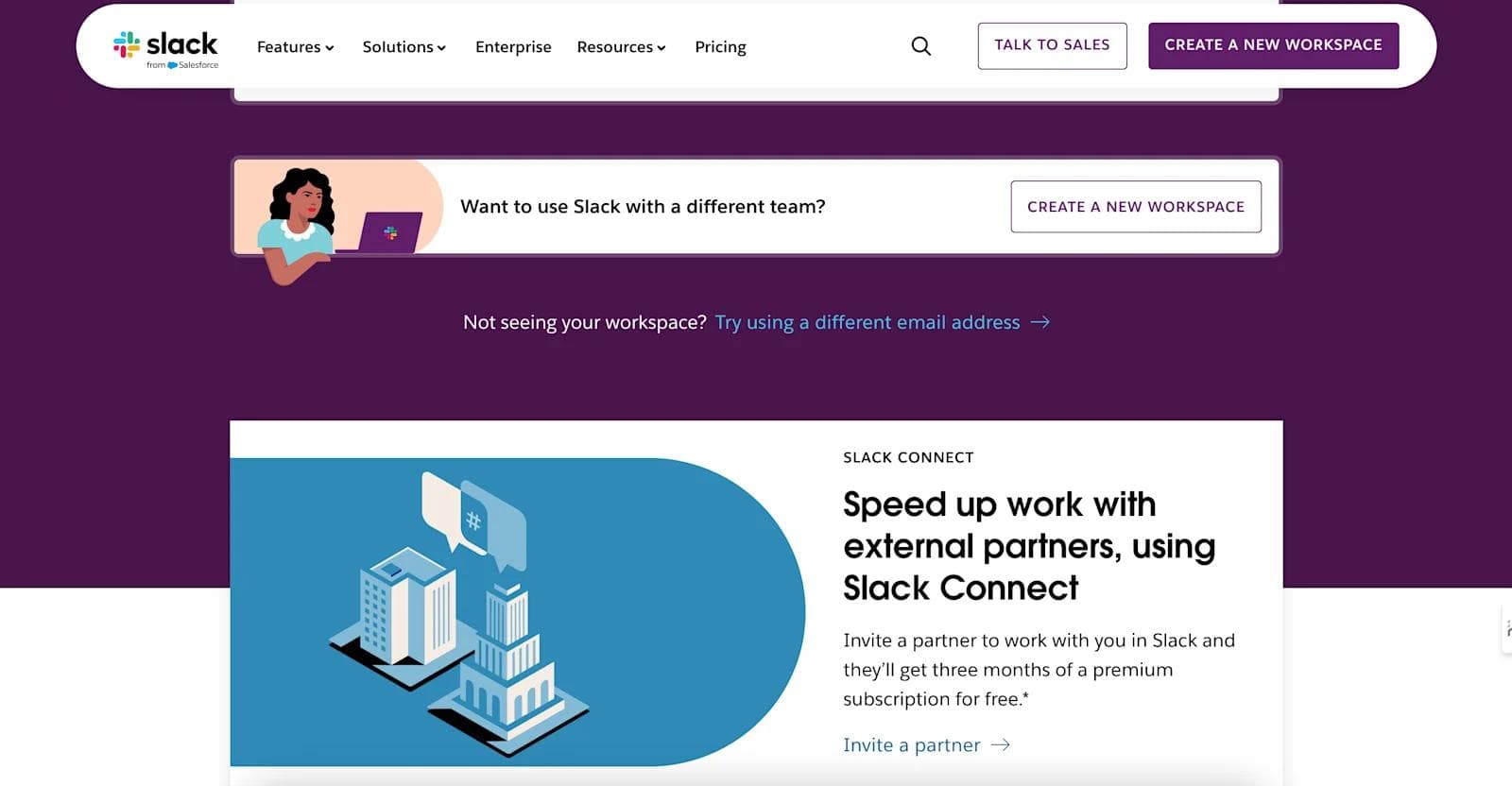
Slack's landing page follows the best B2B website best practices as it features a clear headline, a concise subheadline, and a strong CTA. The page uses high-quality visuals and customer testimonials to build trust. The design is clean, with plenty of white space, making it easy to navigate.
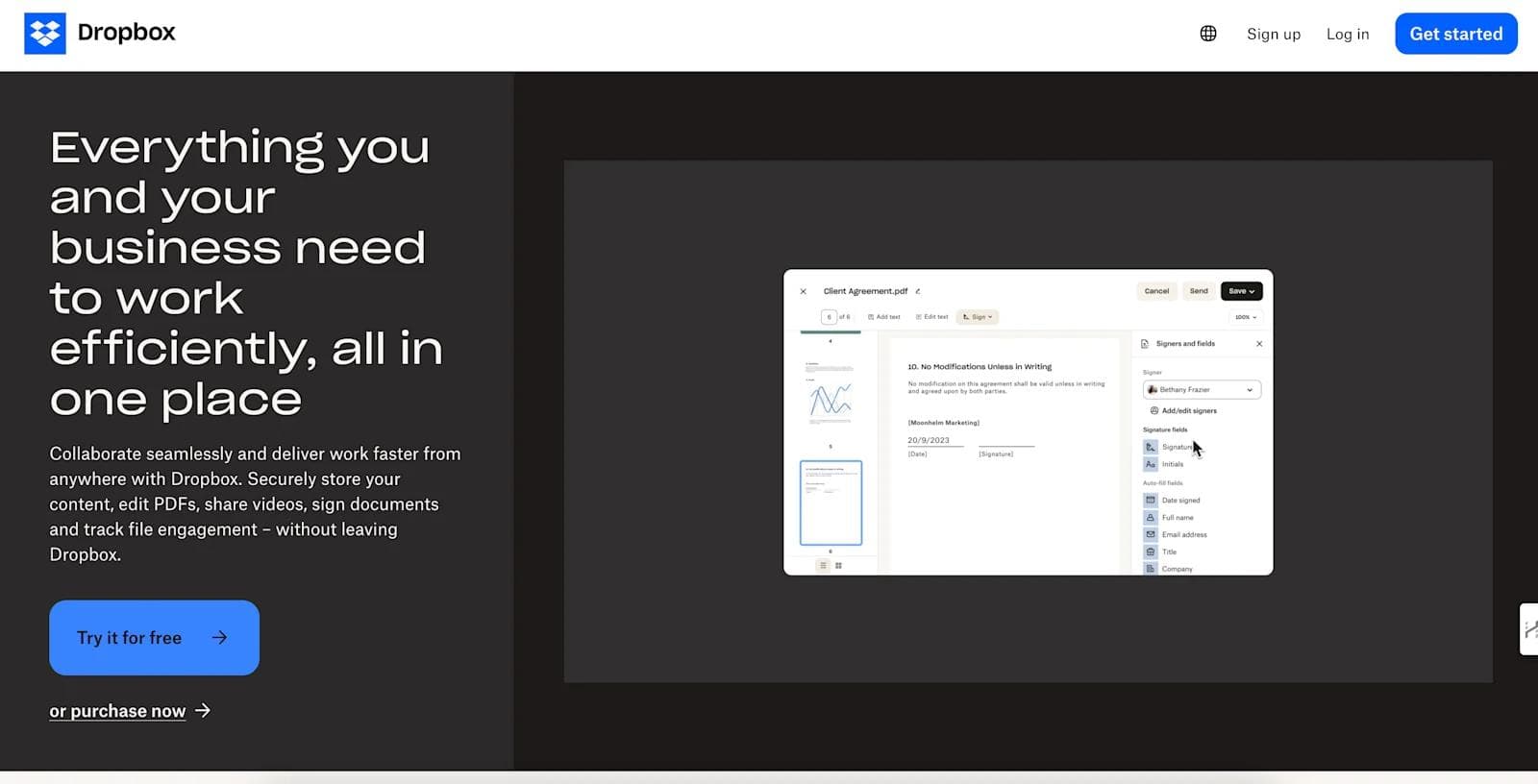
Dropbox Business offers another great example. Their landing page highlights the benefits of their product with a compelling headline and subheadline. The CTA is prominent and encourages visitors to start a free trial. The page also includes social proof with logos of well-known clients and testimonials.
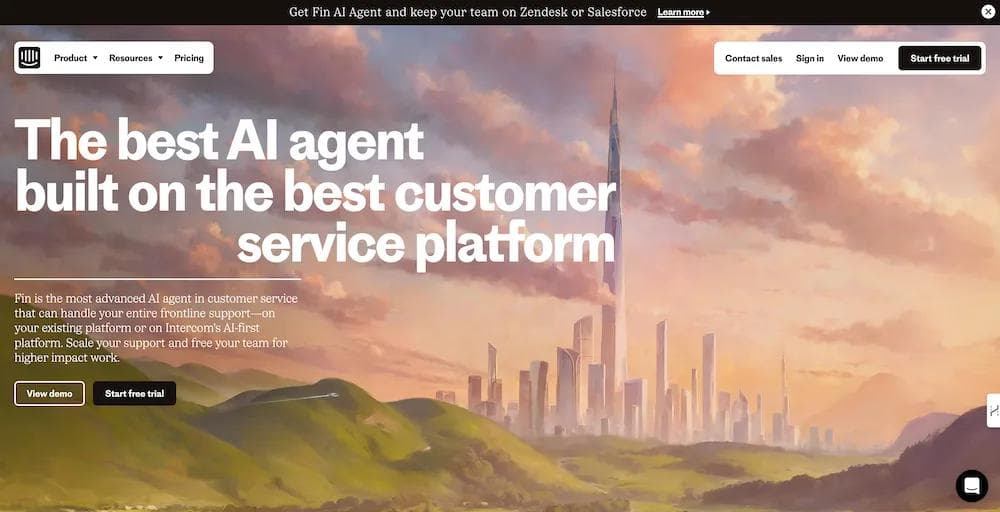
Intercom's landing page is also worth noting. It uses a clear headline and subheadline to address the visitor's needs. The CTA stands out with a contrasting color. The page includes high-quality visuals, customer testimonials, and a simple, clean design that guides the visitor toward conversion.
Even well-designed landing pages fail when undermined by common strategic mistakes. Knowing what to avoid is as important as knowing what to implement.
See what’s working for industry-leading websites and find inspiration to improve yours.

Our Take on SaaS Website Conversions
Through our work with B2B SaaS companies, we've observed consistent patterns in what drives conversion performance. The most successful approaches share common characteristics.
Conversion optimization in B2B SaaS hinges on clarity and alignment. Your website must communicate product value quickly and precisely, matching how buyers actually evaluate solutions in your category. Streamlined navigation and intuitive interfaces reduce friction, but only if they guide users toward actions that match their current stage in the buying process.
The technical foundation matters more than most teams realize. Composable architecture enables faster testing cycles and iteration. Headless CMS platforms let marketing teams optimize conversion flows without development dependencies. This technical flexibility compounds over time, allowing continuous improvement rather than periodic redesign cycles. The companies that consistently outperform conversion benchmarks treat their website as a product that evolves based on data, not a static asset that launches and stagnates.
Common SaaS Website Conversion Mistakes
Most conversion problems stem from predictable mistakes. Recognizing these patterns in your own site helps you diagnose issues faster and avoid repeating common errors.
- One frequent issue is a complicated user interface. If visitors can't navigate your site easily, they'll leave before converting.
- Another common mistake is having a slow-loading website. Speed matters; if your site takes too long to load, potential customers will bounce.
- Poorly crafted CTAs can also hurt conversions. If your calls-to-action are vague or hidden, users won't know what steps to take next.
- Lastly, neglecting mobile optimization is a significant error. With more users accessing sites via mobile, a non-responsive design can lead to lost opportunities.
Avoiding mistakes prevents performance from degrading. Identifying missed opportunities actively improves it. This requires systematic examination of where you're losing potential conversions.
Identifying Missed Conversion Opportunities
To identify missed opportunities, start by analyzing user behavior on your site and by doing a B2B competitor analysis.
- Use tools like heatmaps and session recordings to see where users click and where they drop off. Look for pages with high bounce rates or low engagement. These are often areas where you're losing potential conversions.
- Check your analytics for underperforming CTAs. If certain buttons or links aren't getting clicks, they may need redesigning or repositioning.
- Also, review your forms. Are they too long or asking for unnecessary information? Simplifying forms can reduce friction and increase submissions.
Expert Tips to Maximize SaaS Conversions
Maximizing conversions requires coordinating multiple elements into a cohesive system. Building a scalable website foundation ensures these optimizations compound over time rather than create technical debt. These recommendations address the integration layer, where individual tactics combine into compound effects.
- Start with a clean, intuitive design that guides visitors smoothly through your site.
- Ensure your website loads quickly by optimizing images and leveraging browser caching. Make your CTAs clear and compelling.
- Use action-oriented language and place them prominently on your pages.
- Implement A/B testing to find the most effective versions of your CTAs, headlines, and layouts.
- Offer free trials or demos to give users a risk-free way to experience your product.
- Finally, leverage social proof by showcasing testimonials, reviews, and client logos to build trust and credibility.
Sustainable conversion improvement comes from systematic optimization, not one-time fixes. Start by establishing accurate measurement and identifying your primary bottleneck. Address the highest-impact friction point first. Once improved, move to the next bottleneck. This sequential approach delivers compound improvements over time and builds organizational capability in conversion optimization. The companies that outperform their benchmarks consistently treat conversion optimization as an ongoing discipline, not a project with an end date.
Ready to boost your SaaS website conversions? See the Webstacks difference: Schedule a brief discovery call today. Let us help you achieve your website objectives with cutting-edge design and development.
We partner with high-growth tech brands to design, build, and scale websites that marketers and end-users love.